A stock breaks out, the candles get larger, and every second you wait feels more expensive. You finally enter—just as momentum pauses and pulls back.
Chasing hurts because the move was real. You were right about strength but late to the useful entry. The loss can push you toward two bad habits: buying every fast move or freezing when the next valid breakout appears.
The goal is not to avoid momentum. It is to tell whether momentum is beginning near a clear level or ending near a target.
Choose the right guide: Entering after the move begins? Stay here and measure what remains. Entering before confirmation? Read Why You Keep Entering Good Trades Too Early.
Why fast moves create bad decisions
Price speed feels like proof. A fast move can mean new demand is entering, but it can also mean late traders are rushing in after much of the move is complete.
Momentum alone does not answer:
- Where did the move begin?
- What level was broken?
- Has that level held on a retest?
- Where is the next resistance or target?
- What price would invalidate a new entry?
Without those answers, “strong momentum” can become another name for fear of missing out.
Momentum may be beginning when…
Momentum has a stronger case when price:
- breaks a level that mattered before the move,
- holds or successfully retests that level,
- has clear space to the next decision area,
- forms a nearby invalidation point, and
- continues with healthy participation rather than one final large candle.
None of these conditions guarantees continuation. Together, they create a trade you can plan.
You may be chasing when…
The entry is more likely to be late when:
- price has already traveled most of the distance to the next target,
- the nearest useful invalidation level is far away,
- you cannot name the level that started the move,
- you are entering only because candles are getting bigger, or
- the risk required now is much larger than it was at the original setup.
Think of it like boarding a train. A train leaving the station may still offer a safe door. A train already moving at full speed does not become safer because you run faster.
A manual chase test based on what remains
1. Start with the current price
Write down the actual price where you would enter now. Do not compare the trade with the price you missed. The decision starts from what is available today.
2. Find the nearest realistic target
Mark the next resistance for a long trade or support for a short trade. A target is not a promise. It is the next area where the trade may require a decision.
3. Measure the remaining upside or downside
Measure from the current price to that target. This is the part of the move still available if price reaches the area. A strong move can still be a poor entry when little room remains.
4. Find logical invalidation
Ask what price behavior would prove the momentum setup wrong. If the only logical invalidation is far away, the current entry may require too much risk.
5. Compare reward remaining with risk required
Compare the distance to the target with the distance to invalidation. You do not need a perfect ratio, but the reward still available should justify the risk required under your rules.
If it does not, wait for a fresh setup:
If the first entry is gone, wait for another condition:
- a pullback that holds the breakout level,
- a tight pause with a clear low or high,
- a reclaim after a brief failed break, or
- a new level that creates a closer invalidation point.
No new setup means no trade.
An illustrative example
Suppose a stock breaks resistance at $100 and the next potential target is $104. Entering near $100.50 after a successful retest leaves room to evaluate the trade. Entering at $103.60 because the candles look strong leaves only 40 cents to the target while invalidation may still sit below $100.
The direction can remain correct while the late entry becomes poor.
This example is illustrative and is not a live trade recommendation.
How Eden makes the chase test faster
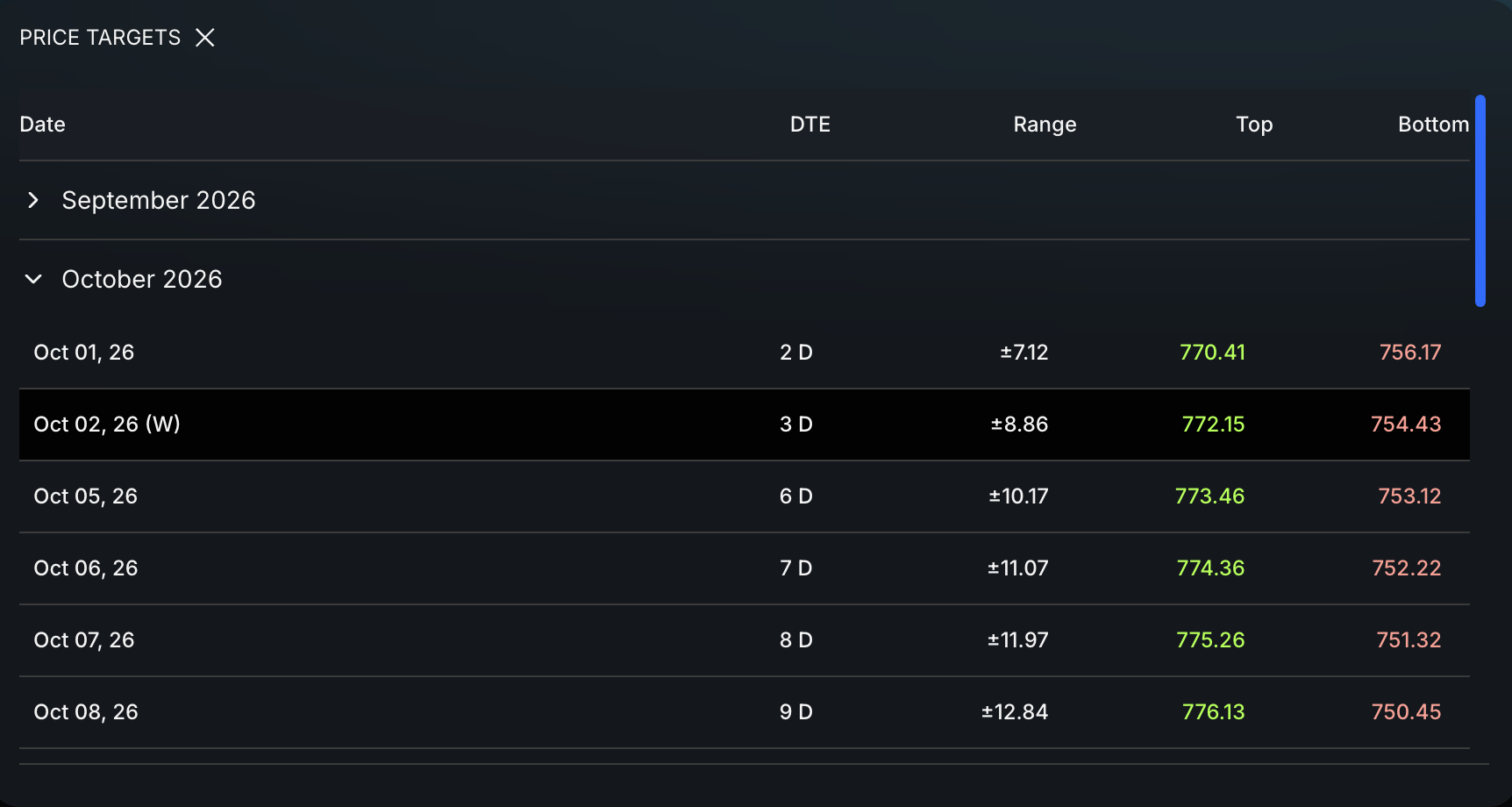
Enter a ticker in Eden and see its current price, nearby key levels, possible invalidation context, and potential price targets in one view. That helps you measure what remains instead of judging momentum by candle size.
Use the workflow:
- Enter the ticker.
- Identify the level behind the move.
- Check the next upside or downside target.
- Define what would invalidate a new entry.
- Wait for a new reaction if the original entry is gone.
Eden does not label a move safe to chase. It shortens the work required to judge the space between the current price, invalidation, and the next target.
If your main problem is entering before the setup completes, read Why You Keep Entering Good Trades Too Early. For more on missed moves, read How to Time a Trade Entry Using Support and Resistance Confirmation.
Frequently asked questions
Is entering after a breakout always chasing?
No. A breakout can be a valid entry when it is part of your plan and includes clear invalidation and room to a target. Chasing means entering mainly because price is moving and you fear missing it.
What if momentum never pulls back?
Then the trade may remain missed. Missing one move is less damaging than building a habit of entering without a plan.
Can volume confirm momentum?
Volume can add context, but it does not replace price location, invalidation, and the next target. Read How to Use Volume Price Analysis at Key Levels for a practical framework.
Takeaway
Momentum is more useful near the start of a level-based move than near the end of the path to a target. Stop chasing by finding the starting level, measuring the remaining room, defining invalidation, and waiting for a fresh setup when the original one is gone.