
Two traders buy calls on the same stock with the same expiration but different strikes. The stock makes the move both expected. One contract responds; the other barely moves. Gamma often explains the difference. Gamma tells you how quickly the option’s delta changes as the stock travels toward your target.
By the end of this page, you should be able to look at an options chain and identify which contract can wake up on that path. Every number below is illustrative, not a live quote or recommendation.
Key takeaways
- Gamma is the rate your delta changes when the stock moves $1. High gamma near your strike means the contract accelerates; low gamma means it crawls.
- Gamma is usually highest near the money and close to expiration. It falls as contracts move farther out of the money or farther out in time.
- For a swing trade, what matters is the gamma between today's price and your target. If delta never wakes up on that path, the contract was the wrong tool.
- Long options are long gamma: acceleration helps, while time decay charges rent. Short options reverse that trade-off.
Gamma in one paragraph, in dollars
Delta estimates how much an option premium changes for the stock’s next $1 move. Gamma estimates how much delta changes after that move.
Consider an illustrative call with 0.30 delta and 0.05 gamma:
- The stock rises $1. Delta moves from about 0.30 to 0.35.
- The stock rises another $1. Delta moves from about 0.35 to 0.40.
- The contract’s response accelerates as price moves in the planned direction.
For one standard contract, a 0.30 delta is roughly $30 of stock-like exposure because the contract represents 100 shares. Gamma adds to or subtracts from that exposure as the stock moves. This simple arithmetic ignores gamma itself changing, but it shows the job gamma performs.
Where gamma lives on the chain
Gamma tends to be largest near the current stock price. A near-expiration at-the-money contract can react quickly because small stock moves change whether it finishes in or out of the money. That makes it a rocket and a cliff at the same time.
Far-out-of-the-money contracts often look cheap because the market assigns a low probability that they finish with value. Their delta may be small, and the gamma ramp may sit beyond any reasonable target. The stock can move in your direction while the contract still responds poorly.
Longer-dated options usually spread their gamma across more time. They may react more steadily, but the acceleration is often smaller today. This is one reason expiration should match the expected holding period in a swing-options plan.
The gamma ramp and why swing traders should care
The gamma ramp is the part of the stock’s path where a contract’s delta begins changing faster. For a directional swing:
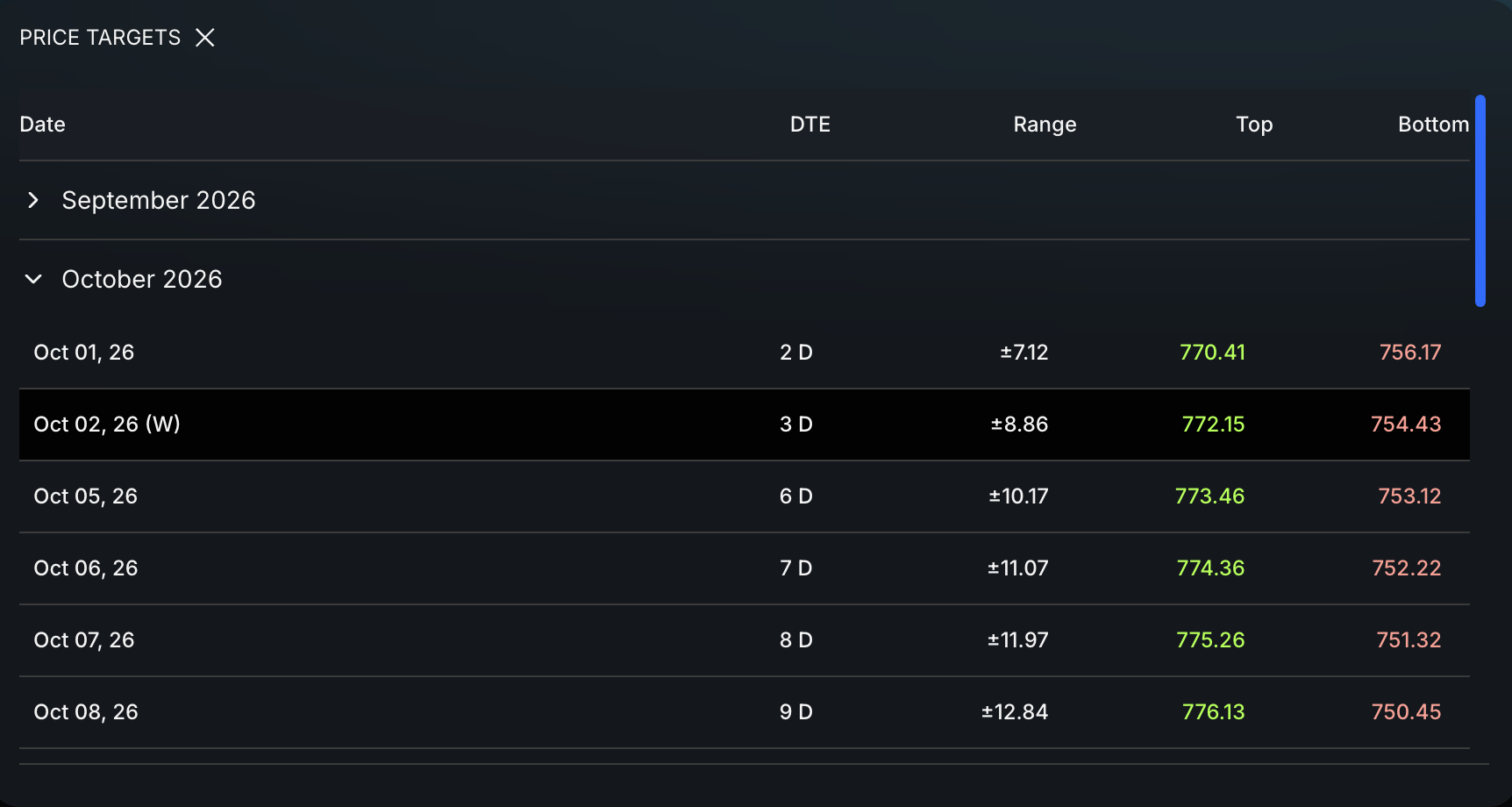
- Choose the price target for the holding period. Eden’s price targets are one source. A do-it-yourself alternative is the at-the-money straddle’s implied move.
- Look at strikes between spot and the target, usually in the 25-to-50-delta range.
- Find the contract whose gamma begins building on that path.
- If no contract has a useful ramp before the target, size down or skip the contract.
The failure mode is choosing a contract only because its premium is cheap or its delta looks acceptable today. The relevant question is what delta can become before price reaches the planned target.
A worked example
Assume a hypothetical stock trades at $100 with an illustrative target of $108. You compare three calls with the same expiration. To keep the whiteboard math simple, the table treats gamma as constant even though real gamma changes with price, volatility, and time.
| Strike | Delta today | Gamma today | Approx. delta at $104 | Approx. delta at $108 |
|---|---|---|---|---|
| $102 call | 0.45 | 0.050 | 0.65 | 0.85 |
| $105 call | 0.35 | 0.040 | 0.51 | 0.67 |
| $110 call | 0.25 | 0.015 | 0.31 | 0.37 |
The approximation is:
Future delta ≈ starting delta + (gamma × stock-price move)
For the $105 call at the midpoint:
0.35 + (0.04 × $4) = 0.51
At the target:
0.35 + (0.04 × $8) = 0.67
The $110 call is cheaper, but its delta barely wakes up by the target in this simplified example. The $102 call accelerates most, but it may also cost more. Gamma helps compare responsiveness; it does not replace price, spread, liquidity, theta, or implied volatility.
Long gamma vs. short gamma: what changes when you sell
When you buy an option, you are long gamma. If the stock moves your way, delta can build and the contract can respond faster. Theta is the rent you pay for that convexity.
When you sell an option, you are short gamma. Theta pays you, but an adverse move can make delta accelerate against the position. The preferred gamma depends on the job. A directional swing usually wants long gamma in the ramp zone. An income trade accepts short-gamma risk for premium and must manage that acceleration.
Contract-selection mistakes gamma explains
- Buying the cheapest contract because it is cheap. Delta may never wake before expiration.
- Buying near the money in a high-volatility name without checking the required move. Direction can be right while volatility and decay overwhelm the result.
- Holding into near-expiration pin risk. Gamma can change sharply around the strike as time runs out.
- Choosing expiration by premium alone. The ramp needs enough time to happen.
Gamma on your own contract is different from market-wide gamma exposure. Contract gamma describes how your delta changes. GEX aggregates gamma and positioning across an options chain to estimate possible hedging pressure.
For a concrete historical example, review the TSLA $410 call trade planned around Eden key levels. The recap shows how the contract was considered only after the stock confirmed the planned $405 trigger.
Frequently asked questions
What is a good gamma for options?
There is no universal number. For a directional swing, look for meaningful gamma between spot and the target, not simply the highest gamma on the chain.
Does gamma matter for swing trading or only day trading?
It matters for both. Gamma becomes more sensitive closer to expiration, but a multi-week swing still needs the contract to respond before the target or expiration arrives.
Is high gamma good or bad?
Neither. Gamma is acceleration. Long options rent it through theta. Short options collect theta while accepting acceleration risk.
How do I find gamma on my broker’s chain?
Open the chain settings and add the Greeks columns. Display gamma beside delta, theta, and implied volatility. Most major options brokers provide it.
Takeaway
Pick the target first. Then choose a liquid contract whose delta can wake up while price travels toward that target. A good chart with a weak contract is still a weak options trade.