
Order flow trading studies transactions coming into a price level. For a security, that means completed trades near a price. For options, it means activity at the contract level: the underlying security, strike, expiration, timestamp, fill, and the bid and ask available when the trade occurred. Order flow shows where money is being committed. It does not guarantee that the activity is bullish, bearish, or predictive.
Trading order flow is harder in options than in equities. Options activity may involve a single contract, a spread, or a hedge. A transaction reported through OPRA does not explain whether it belongs to a multi-leg strategy. The data provides clues, not certainty.
Information and Eden product behavior checked November 4, 2026.
Key takeaways
- Order flow is transactions entering a price level. It is context, not a complete trade.
- The tape shows what traded. The order book shows what is waiting.
- A footprint shows buying and selling activity at individual prices.
- Options flow requires extra care because a fill may be one leg of a larger strategy or hedge.
- No tape print, book level, footprint imbalance, or options order guarantees the next move.
What is order flow trading?
Order flow trading is a method of studying transactions and liquidity to understand how buyers and sellers are behaving around a price area. The goal is not to react to every print. The goal is to decide whether current activity supports, weakens, or invalidates a plan you already understand.
You may also see the term written as orderflow. The spelling changes, but the underlying question is the same: what are completed transactions and nearby liquidity revealing about participation at a price?
In equities, the bid, ask, and fill can support a reasonable estimate. A fill near the ask may reflect aggressive buying; a fill near the bid may reflect aggressive selling. That is still an estimate because the print does not reveal every participant’s intent.
Options add more variables. The same call purchase could be a directional bet, one side of a spread, or a hedge against another position. Frequency, clusters, time gaps, fill location, strike, and expiration can help classify the activity, but none of those details should be read alone.
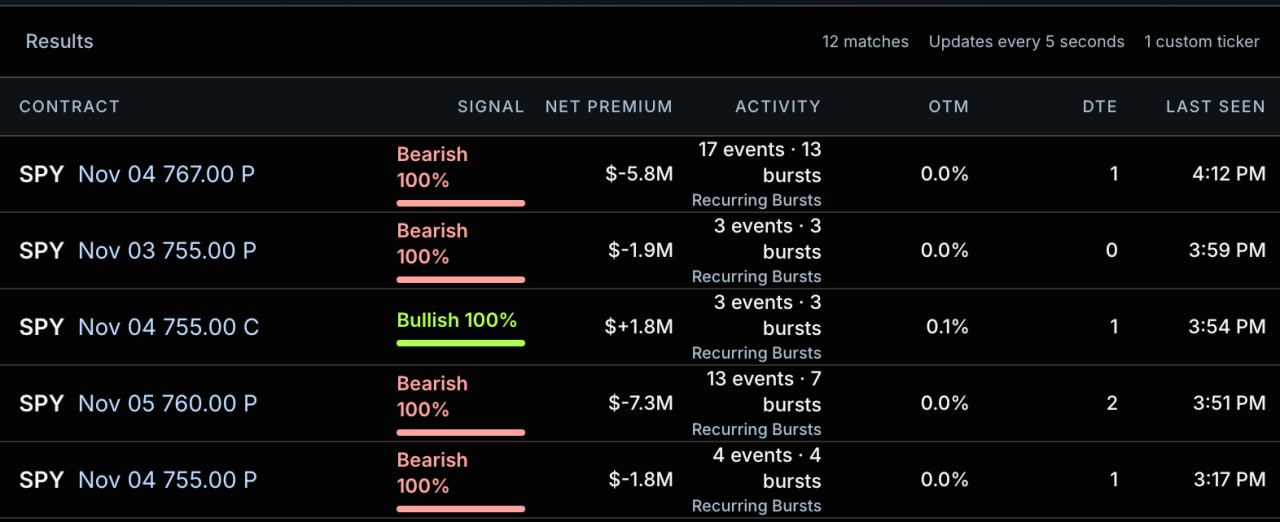
What is order flow in trading?
Order flow is the stream of completed transactions entering the market. It answers what traded, at what price, and when. Depending on the market and data source, it may also show size, bid and ask context, contract details, and changes in resting liquidity.
These terms describe different views:
| View | What it shows | Main limitation |
|---|---|---|
| Tape | Completed trades | A print does not reveal the full strategy or intent |
| Order book or DOM | Resting bids and offers | Orders can be moved or canceled before filling |
| Footprint chart | Buying and selling volume at each price | Classification and aggregation depend on the platform |
| Options flow | Filled option contracts with strike and expiration | A fill may belong to a spread or hedge |
The distinction matters. A filled trade happened. A resting order may never trade. Neither one, by itself, tells you where to enter, where the idea is wrong, or where to take profit.
How does order flow trading work?
Order flow trading works by comparing activity with a price area that already matters. The tape shows completed transactions. The book shows displayed liquidity waiting to trade. A footprint organizes volume at price. Imbalance and delta summarize buying and selling pressure under a platform’s rules.
The tools can disagree because they answer different questions. A large resting bid may disappear. Strong positive delta may appear after much of the move is complete. A large options print may be a hedge instead of a directional bet.
Spoofing is another reason to separate the book from completed trades. A participant can place a resting order and cancel it before execution. That displayed order is not the same as a fill. Options transactions received through OPRA are completed trades, so they cannot be spoofed in that same resting-order sense. Their intent can still be ambiguous.
How to read order flow in trading
Do not begin by staring at every tape print, DOM update, or footprint cell. Begin with the decision areas.
- Mark two or three levels where price could react.
- Give each level a job: support, resistance, entry area, target, or invalidation.
- Watch for order flow around the area, not only at one exact price.
- Ask whether the activity supports the level’s job or shows that it is weakening.
- Define the line where the idea is wrong before entering.
Eden’s role is to make the options activity easier to classify around those areas. It records the spot price, the level around which a trade occurred, and whether the activity leans bullish or bearish based on multiple parameters. That signal is still supporting evidence, not a complete trade.
For a broader structure-first workflow, use the guide to support and resistance trading. You can also compare traditional lines with options-derived support and resistance.
Order flow trading strategy
An order flow trading strategy needs a level, a confirmation, an invalidation, a target, and a position size. Flow can strengthen the reason for a trade, but it does not replace those decisions.
Use this five-part plan:
- Mark two or three levels that matter to the trade horizon.
- Label the job of each level.
- Write the order-flow confirmation you need.
- Set the line where the idea is wrong and size the trade from that loss.
- Run the sleep test: if the position moves against you overnight, is the planned loss still acceptable?
For example, suppose SPY approaches Eden’s bullish momentum level. The plan is not simply “buy at the level.” First, watch whether bullish option orders appear around that area as price approaches or moves above it. If the activity supports the level and price confirms, the level can become an entry reference. If the activity weakens or price cannot hold the area, the trade may not qualify.
P-Trans is Eden’s bullish transition reference, while N-Trans is its bearish transition reference. On SPY, each one marks a decision area where the expected momentum role may change. Neither is a guaranteed reversal or an instruction to trade.
For more premarket context, see where to get SPY and QQQ key levels before the market opens.
Options order flow vs futures order flow
Options and futures traders use the phrase “order flow” for related but different data.
| Decision | Options order flow | Futures order flow |
|---|---|---|
| Main objects | Contracts, strikes, expirations, premium | Futures contracts and prices |
| Common views | Sweeps, blocks, unusual options activity, premium, expiration | DOM, footprint, delta, imbalance |
| Core ambiguity | A fill may be part of a spread or hedge | Resting liquidity may be canceled or moved |
| Eden’s role | Options-derived levels, targets, and classified activity | Planning proxy through related ETFs, not raw futures tape |
Eden is options-derived. It is not a DOM, footprint, or futures execution platform. For ES, traders can use SPY options levels as a planning proxy. For NQ and Nasdaq-100 context, use QQQ options levels as the proxy. For GC, use the GLD options-level workflow.
The honest futures workflow is to build the plan in Eden, then use the futures platform for DOM, footprint, execution, and risk. Eden does not publish ES, NQ, MES, or MNQ levels, execute futures trades, or act as a broker.
Order flow tools
Order flow trading software can emphasize completed trades, resting liquidity, volume at price, options activity, or planning levels. The correct tool depends on the job it needs to do.
| Tool | Job | What it shows | Best for | Price | Trial or entry point |
|---|---|---|---|---|---|
| Eden | Options-derived planning levels and targets | Key levels, momentum references, and dated targets | Planning around options positioning | $39/month | 7-day free trial |
MotiveWave, ATAS, Bookmap, and NinjaTrader are commonly associated with order-flow workflows, but their current features, pricing, and trial terms are not compared here because we have not completed a first-hand review of each platform.
How Eden fits, and where it does not
Eden is the planning layer. It helps a trader map entries, targets, momentum references, and the line where a trade idea is wrong. It can also make options activity around a level easier to interpret.
Eden is not a DOM, a footprint chart, or a raw futures tape. It does not replace MotiveWave or ATAS for a trader whose process depends on those views. It does not execute futures or place trades.
The practical division of labor is simple:
- Use Eden to mark the options-derived plan.
- Use SPY as the planning proxy for ES and QQQ as the Nasdaq-100 planning proxy for NQ.
- Use the futures platform for live DOM, footprint, execution, and risk controls.
- Recheck the plan when price reaches an important level or the positioning changes.
When order flow fails
Order flow fails when activity is misclassified, arrives too late, belongs to a hedge, changes before price confirms, or appears near a level that does not hold.
Options activity is especially easy to overread. OPRA provides the completed transaction, timestamp, fill, bid and ask context, contract, strike, and expiration. It does not tell you with certainty whether the trade is one leg of a multi-leg position.
Resting orders have a different failure mode. A trader can display an order in the book and cancel it before it fills. That is why a large displayed order is not the same as completed buying or selling. Do not write off every canceled order as spoofing, but do not treat displayed size as a promise either.
Plan for failure before entry:
- Require price confirmation at the level.
- Define the exact hold, break, or close that invalidates the idea.
- Size the trade so that invalidation creates an acceptable loss.
- Do not widen risk because a flow signal looked strong.
- Reassess when the activity or market structure changes.
Frequently Asked Questions
What is order flow trading?
Order flow trading studies completed transactions and, depending on the market and tool, resting orders to judge how buyers and sellers are behaving near a price area. It provides context for a plan; it is not a trade or a guaranteed signal.
What is order flow?
Order flow is the stream of transactions entering a price level. For an option, it also includes the contract, strike, expiration, timestamp, fill, and the bid and ask available when the trade occurred.
How does order flow trading work?
A trader compares completed trades, resting liquidity, imbalances, and delta with important price levels. The trader then defines the confirmation, invalidation, target, and risk instead of trading one data point alone.
How to read order flow in trading?
Start with two or three important levels, then look for flow around those areas that supports or weakens the level’s expected job. Record where price was, where the transaction occurred, and whether the activity leaned bullish or bearish.
How to learn order flow trading?
Learn the difference between completed trades and resting orders first. Then review one market, one or two tools, and replay examples around premarked levels while recording the confirmation and invalidation you would have used.
What is delta in order flow?
Delta is the difference between buying volume and selling volume under a tool’s classification method. Positive or negative delta can describe pressure, but it does not prove where price must move next.
What is payment for order flow?
Payment for order flow is a broker-routing arrangement in which a broker may receive compensation for sending orders to a market maker. It is different from order flow trading and is not a trading strategy.
Takeaway
Order flow is evidence around a decision area. It is not the decision itself. Mark the level, define its job, require confirmation, set the line where the idea is wrong, and size the loss before the trade.
Tape, book, footprint, and options flow each show a different part of the market. Use the view that matches the job, and keep the risk plan independent from any single signal.