
Key takeaways
- A prop firm challenge is a risk-management audition, not a race to the profit target.
- The loss and drawdown rules matter more than any single winning trade.
- Turn the firm's limits into smaller personal limits before the first session.
- Plan the entry, invalidation, target, and size before placing each order.
- Eden can support that planning process, but it cannot guarantee that a trader passes an evaluation.
The practical way to pass a prop firm challenge is to protect the account long enough for a tested process to reach the target. Read every rule, trade smaller than the maximum allowed, stop before the firm’s loss limit, and reject any trade that does not have a written entry, invalidation, and target.
That sounds slower than chasing a big day. It is. It is also closer to the job the evaluation is testing.
What is a prop firm challenge?
A prop firm challenge, sometimes called an evaluation or trading combine, is a simulated trading account with objectives and risk rules. The trader usually pays a fee, trades under the firm’s rule set, and becomes eligible for a funded stage only after meeting every applicable objective.
The details vary. A challenge may include:
| Rule or objective | What to verify before buying |
|---|---|
| Profit target | The net profit required, and whether all positions must be closed |
| Daily loss limit | Whether it uses balance, equity, unrealized P&L, fees, or a reset time |
| Maximum drawdown | Whether it is static, end-of-day trailing, or intraday trailing |
| Minimum trading days | How a trading day is counted |
| Consistency rule | How much of total profit may come from one day |
| Position limits | Maximum contracts, lots, shares, or open risk |
| Restricted activity | News trading, overnight holding, automation, copy trading, or prohibited strategies |
One-step evaluations use one qualifying stage. Two-step evaluations require a challenge and a verification stage. “Instant funding” products can skip a traditional profit-target phase, but they still impose account and payout rules. The label is not enough. Read the current rule page for the exact product you are buying.
For example, Topstep’s current Trading Combine parameters describe a maximum-loss rule, a profit target, and a consistency target. FTMO’s current objectives differ across its one-step, two-step, and instant products. A plan built for one rule set can fail under another.
Why most traders fail the evaluation
The profit target gets the attention. The loss boundary ends the attempt.
Traders often fail by:
- sizing from the displayed account balance instead of the actual drawdown allowance,
- taking another trade after reaching a sensible personal daily stop,
- increasing size after a loss,
- forcing low-quality setups because the target feels close,
- misunderstanding whether a drawdown trails intraday or at the end of the day,
- or forgetting that unrealized losses and fees may count toward a limit.
Do not treat a “$100,000 account” as $100,000 of usable risk. If the firm permits only a small maximum drawdown, that drawdown—not the headline balance—is the real operating budget.
Build the evaluation plan before the first trade
1. Read every rule before buying
Copy the firm’s current rules into one page. Record the profit target, daily loss limit, maximum drawdown, consistency calculation, minimum days, reset time, position cap, and restricted trading behavior.
Then answer two questions:
- What exact event fails the account?
- What exact event merely pauses trading or extends the target?
Those outcomes are not always the same. FTMO says a breach of its maximum-loss or maximum-daily-loss rule fails the account. Topstep currently describes its optional Daily Loss Limit as a forced break rather than a failed combine, while hitting its Maximum Loss Limit ends the account. Verify the current rules yourself; they can change.
2. Size from the drawdown, not the account label
Many trading educators use roughly 0.5% to 1% of account equity per trade as a starting heuristic. A prop evaluation needs another check: the dollar risk must also be small relative to the firm’s remaining drawdown.
Use this arithmetic:
Dollar risk per trade = distance from entry to invalidation × position size
If the planned entry is 100, the invalidation is 98, and the personal loss budget is $100, the maximum size from that plan is 50 shares. That calculation does not guarantee a $100 loss; gaps, slippage, commissions, and fast markets can make the result worse.
The sleep test is simple: if one ordinary stopped trade makes you feel that you must win the next trade back, the size is probably too large for the evaluation.
3. Set a personal daily stop inside the firm’s limit
The firm’s daily limit is the emergency wall. Your personal limit should sit inside it.
Leave room for commissions, slippage, open positions, and calculation differences. Stop trading when your personal limit is reached. Do not make the firm’s liquidation logic your normal exit plan.
4. Build a daily pass pace around the consistency rule
The daily plan needs both a loss limit and a profit pace. The profit number is not a quota that must be forced. It is a ceiling that shows when the day’s job is done.
Start with the firm’s published profit target and consistency percentage:
Maximum best day before the target changes = profit target × consistency cap
Minimum final profit required after a large day = best-day profit ÷ consistency cap
Planned daily pace = profit target ÷ planned number of winning days
The planned number of winning days must be large enough for one day to remain inside the consistency cap:
Minimum evenly profitable days = round up (1 ÷ consistency cap)
For a 55% consistency cap, 1 ÷ 0.55 = 1.82, so at least two evenly profitable days are needed. For a 30% cap, 1 ÷ 0.30 = 3.33, so at least four are needed.
Using Topstep’s current $50K Trading Combine as an example:
- published profit target: $3,000,
- current consistency cap: 55%,
- maximum best day before the target increases: $3,000 × 0.55 = $1,650,
- two-day pace: $3,000 ÷ 2 = $1,500 per profitable day.
Two $1,500 days would put the best day at 50% of $3,000. A $1,700 first day would exceed the original $1,650 best-day threshold. If $1,700 remained the best day, the trader would need at least $1,700 ÷ 0.55 = $3,090.91 in total profit to bring that day back within 55%.
This arithmetic describes the rule; it does not predict what the market will offer. If no valid setup appears, the correct daily profit is zero. Never manufacture a trade to keep pace with a spreadsheet.
Copy this evaluation-planning prompt into ChatGPT or another AI tool
First, copy the current rules from the prop firm’s official page or dashboard. Then replace the brackets below and paste the complete prompt into the AI tool you use:
I am planning a prop firm evaluation. Use only the rules and numbers I paste below.
Do not guess any missing rule. Flag missing information and tell me what I need to verify
with the firm. Do not promise that I will pass and do not create trade signals.

Firm and product: [NAME]
Account label: [AMOUNT]
Profit target: [AMOUNT]
Consistency cap: [PERCENT, OR NONE]
Minimum trading days: [NUMBER, OR NONE]
Firm daily loss limit: [AMOUNT AND HOW IT IS CALCULATED]
Maximum drawdown: [AMOUNT AND WHETHER STATIC, END-OF-DAY TRAILING, OR INTRADAY TRAILING]
Maximum position size: [CONTRACTS]
My planned number of profitable days: [NUMBER]
My personal daily stop: [AMOUNT]
My personal loss limit per trade: [AMOUNT]
Contract: [ES, MES, NQ, MNQ, RTY, M2K, GC, MGC, OR ANOTHER CONTRACT]
Dollars per point for that contract: [AMOUNT]
Typical stop distance in points: [POINTS]

Build a simple evaluation plan that calculates:
1. Maximum best day = profit target × consistency cap.
2. Minimum total profit required if my best day exceeds that amount
   = best-day profit ÷ consistency cap.
3. Minimum evenly profitable days = round up (1 ÷ consistency cap).
4. Planned daily pace = profit target ÷ planned profitable days.
5. Risk per contract = stop distance × dollars per point.
6. Risk-based contract count = round down (personal loss limit per trade ÷ risk per contract).
7. Actual maximum contracts = the smaller of the firm's cap and the risk-based count.
8. Maximum full-risk attempts = round down (personal daily stop ÷ personal loss limit per trade).

Show the formulas, calculations, and a one-page daily checklist. Treat the daily profit
pace as a ceiling, not a quota. If there is no valid setup, say the correct action is no trade.
Leave room for commissions and slippage. Remind me to verify every result against the
firm's current dashboard before trading.

Official rules pasted below:
[PASTE THE COMPLETE CURRENT RULES HERE]
AI can organize the arithmetic, but it can misread a rule or use stale information. Compare every output with the firm’s live dashboard. The firm—not the AI response—is the authority on whether an account passes or fails.
5. Calculate futures contract size from the hard stop
The platform’s maximum contract count is not the position size. It is only the largest position the rules permit. The trade’s stop distance and personal loss budget determine the usable size.
For futures:
Risk per contract = stop distance in points × dollars per point
Risk-based contract count = round down (personal trade loss limit ÷ risk per contract)
Actual contract count = the smaller of the firm’s contract cap and the risk-based contract count
CME lists ES at $50 per index point and MES at $5 per index point. If the chart requires a five-point stop and the personal trade loss limit is $250:
- one ES contract risks
5 × $50 = $250, so the risk-based size is one ES contract; - one MES contract risks
5 × $5 = $25, so the risk-based size is ten MES contracts; - commissions and slippage still need room inside the personal limit.
If the firm allows five ES contracts, that permission does not make five contracts appropriate. With the same five-point stop, five ES contracts would place $1,250 at risk before costs. The stop must come from the setup; contract count is the variable that changes.
The daily stop can also cap the number of attempts:
Maximum full-risk attempts = round down (personal daily stop ÷ personal trade loss limit)
With a $500 personal daily stop and $250 of planned risk per trade, the plan permits no more than two full-risk stopped trades. After that, trading stops for the session. A trader can choose less risk or fewer attempts, but should not increase size to recover the loss.
6. Use Eden to build the pre-trade map
Once the evaluation risk plan is written, build the market plan before every order. A trade plan needs four numbers:
- the entry or confirmation trigger,
- the price that invalidates the idea,
- the target,
- and the size created by the entry-to-invalidation distance.
Eden adds structure, momentum, options-derived key levels, and expected-move price targets for the related stock or ETF. Use those inputs to decide where to pay attention. Use the actual instrument’s chart to confirm and execute the trade.
Before a futures evaluation trade:
- Open the futures chart. Mark its native trend, session structure, and the stop location required by the setup.
- Open the related ETF in Eden. Use the ETF as a second context map, not as a substitute futures quote.
- Check structure and momentum. Decide whether the larger context is bullish, bearish, mixed, strengthening, or weakening.
- Mark P-Trans and N-Trans. Watch the bullish and bearish transition levels for a hold, reclaim, rejection, or break on the ETF chart.
- Mark nearby areas of interest and price targets. These can frame possible reaction areas and destinations.
- Return to the futures chart. Define the actual futures entry, stop, target, and contract size there.
- Compare the risk with the evaluation plan. Skip or reduce the trade if it exceeds the personal trade loss, daily stop, remaining drawdown, or consistency pace.
Use these common related-market pairs:
| Futures contract | Related ticker to open in Eden | Shared market context |
|---|---|---|
| ES or MES | SPY | S&P 500 |
| NQ or MNQ | QQQ | Nasdaq-100 |
| RTY or M2K | IWM | Russell 2000 small caps |
| GC or MGC | GLD | Gold |
| SI | SLV | Silver |
The pair shares a market theme, not a price scale. SPY levels do not get pasted onto an ES chart. QQQ prices are not NQ prices. IWM, GLD, and SLV also have different trading hours, mechanics, and tracking behavior from their related futures contracts. Keep both charts visible and execute from the futures chart.
For a bullish ETF plan, a trader might use Eden’s P-Trans as a bullish trigger, place invalidation below the relevant bearish level or chart structure, and choose an expected-move target that fits the holding period. For a bearish plan, the roles reverse: N-Trans can be the trigger, while a reclaim above the relevant bullish level or structure may invalidate the idea.
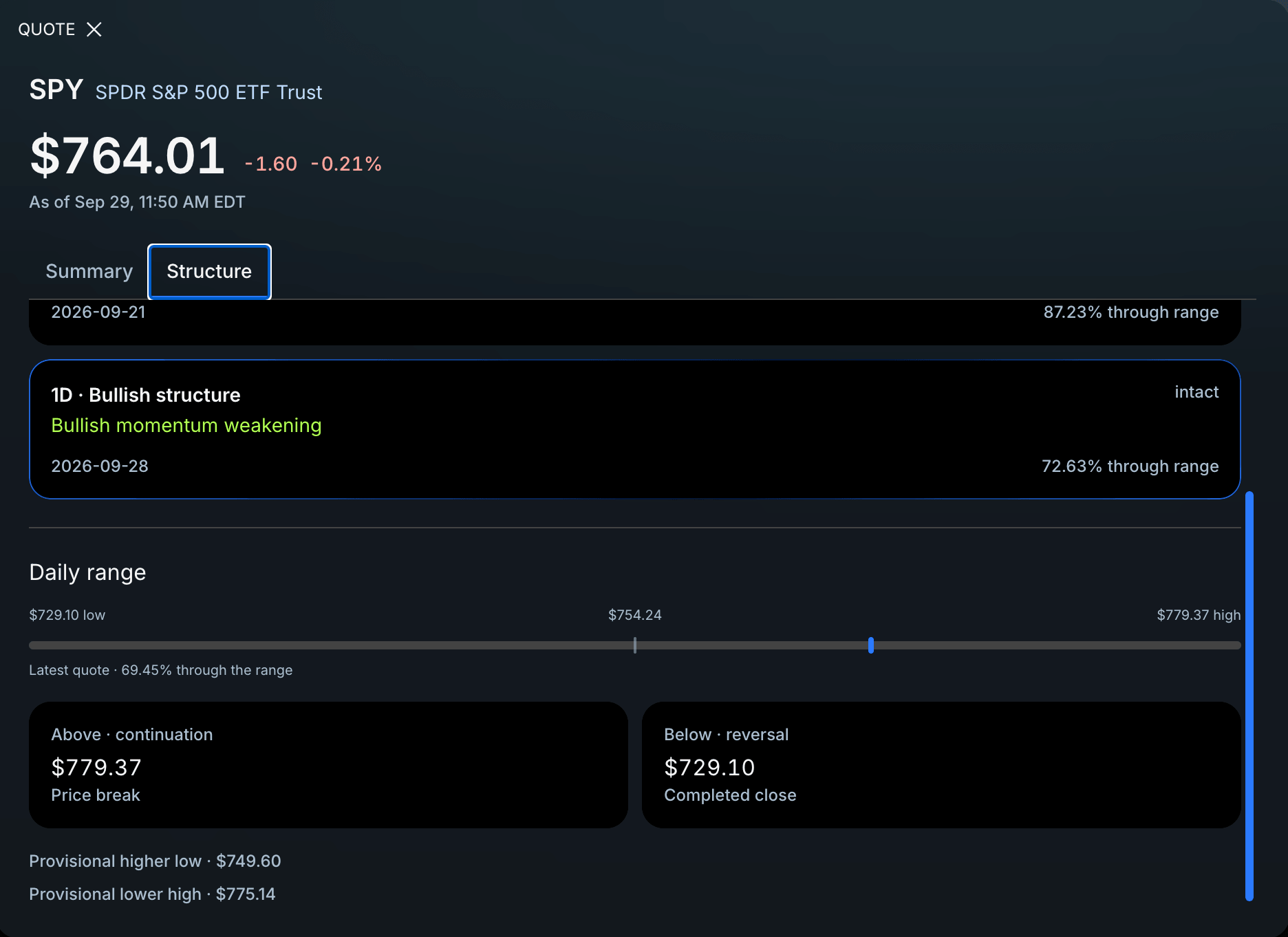
The screenshot above shows why the map comes before the order. Structure, continuation and reversal prices, and the daily range are visible together. The numbers are a historical interface example, not a current recommendation.
A worked planning example
Assume a supported ETF shows a bullish trigger at 500, an invalidation at 496, and a potential target at 510. The plan risks 4 points to pursue 10 points.
If the personal loss budget is $80, the arithmetic allows 20 shares before costs and slippage:
$80 ÷ $4 = 20 shares
The trader still waits for the trigger. No trigger means no trade. If the firm dashboard shows that $80 is too large relative to the remaining daily or maximum-loss buffer, the trader reduces size or skips the setup.
This is the role Eden can play: organize options-derived key levels and expected-move targets for more than 6,000 supported US optionable stocks and ETFs. Eden does not enforce the prop firm’s rules, place the order, or decide whether the setup is valid.
For the full proxy workflow, read The Futures Trader’s Guide to ETF Options Levels. It includes SPY/ES, QQQ/NQ, IWM/RTY, GLD/GC, SLV/SI, and other related markets.
7. Trade only tested setups
A prop trading strategy should be specific enough to reject trades. Define the market, session, setup, trigger, invalidation, target logic, and conditions that cancel the idea.
An evaluation is a poor place to invent a new strategy. Use replay or a simulator first. During the challenge, take only the setups that match the written rules.
8. Reduce risk after drawdown or near the target
When the drawdown buffer shrinks, the position size should not stay automatic. A smaller size can preserve another attempt without changing the setup.
Near the profit target, check the consistency rule before pressing. One oversized winning day may increase the amount of profit required. Topstep currently says its best day should remain below 55% of the profit target, while FTMO applies different consistency rules by product. The dashboard is the source of truth.
9. Review the day without grading only the P&L
Record four separate results:
- setup quality,
- execution quality,
- rule compliance,
- and financial outcome.
A planned loss can be acceptable process. A lucky rule-breaking win is still bad process. Use a futures trading scorecard to keep those results separate.
How to pass a futures prop firm challenge
Futures evaluations often center on liquid index contracts such as ES and NQ. Their Micro E-mini equivalents, MES and MNQ, are one-tenth the size of the E-mini contracts, according to CME Group’s Micro E-mini guide. That smaller multiplier can make risk calibration more precise, but it does not make a weak setup safe.
Trade when your tested setup is designed to operate, not merely whenever the futures market is open. Before each session:
- confirm the firm’s loss and position limits,
- mark the futures chart’s native structure,
- define the entry, invalidation, and target,
- calculate the contract size from the stop distance,
- and stop at the personal daily limit.
Eden does not publish ES, NQ, MES, or MNQ futures-contract data. Some traders use SPY options-derived levels as context for ES, or QQQ levels as context for NQ, because the markets are related. That is a proxy, not a direct futures level. Keep the actual trigger, stop, and execution on the futures chart. The SPY, QQQ, ES, and NQ guide explains the boundary.
Futures vs. stock and options evaluations
The planning job is similar, but the mechanics differ.
| Evaluation type | What needs extra attention |
|---|---|
| Futures | Contract multiplier, tick value, session reset, trailing drawdown, and position limits |
| Stocks | Share size, buying power, short availability, gaps, and settlement or margin rules |
| Options | Contract liquidity, spread, expiration, time decay, volatility, and assignment risk |
Do not carry a position-sizing shortcut from one market into another. Convert every stop distance into dollars using the actual instrument.
How fast can you pass a prop firm challenge?
The honest answer is: no faster than the rules and your valid setups allow.
Some firms permit a pass in only a few days; others require minimum trading days or a second stage. Topstep currently says a Trading Combine can pass in as few as two days if its profit and consistency objectives are met. FTMO’s two-step product currently requires at least four trading days in each phase.
That does not make “as fast as possible” a sound trading objective. Speed creates pressure to:
- trade outside the setup,
- increase size,
- ignore the personal daily stop,
- and protect a deadline instead of the account.
Measure progress by rule-compliant sessions and well-executed setups. The target is a consequence, not a reason to take the next trade.
If you want a reusable planning sequence before attempting the evaluation, work through The Set It and Forget It Swing-Trade Blueprint.
Frequently Asked Questions
How hard is it to pass a prop firm challenge?
It is difficult because you must reach a profit objective while staying inside every loss, drawdown, trading-day, and consistency rule. The exact difficulty depends on the firm’s current rules and whether your tested process fits those limits.
How do you pass a futures prop firm challenge?
Read the current rule set, convert every limit into a personal risk budget, trade only tested setups, and use contract size that leaves room for normal losses. Micros such as MES or MNQ can make position sizing more precise, but smaller contracts do not remove market risk.
How fast can you pass a prop firm challenge?
Only as fast as the firm’s current minimum-day and consistency rules permit, and a quick pass should not be the primary goal. Forcing trades or increasing size to hit the target sooner can put the drawdown limit at risk.
What happens if you break a drawdown rule?
The result depends on the firm and product. A hard maximum-loss breach can fail or close the evaluation, while some daily limits only flatten positions and pause trading, so read the current rules before placing the first trade.
What tools help you pass a prop firm challenge?
Use the firm’s own dashboard for official limits, a journal for reviewing execution, and a planning tool for entries, stops, and targets. Eden can provide options-derived levels and expected-move targets for supported stocks and ETFs, but no tool can guarantee a pass.
Official sources
- Topstep, Trading Combine parameters
- Topstep, Maximum Loss Limit
- Topstep, Daily Loss Limit
- FTMO, Trading Objectives
- FTMO, What happens when a Trading Objective is violated
- CME Group, Micro E-mini equity-index futures FAQ
Takeaway
Do not try to beat the evaluation in one trade. Build a rule sheet, set personal limits inside the firm’s limits, and take only trades with a written entry, invalidation, target, and size. Protect the opportunity to trade tomorrow.