
Key takeaways
- FundedNext's current public Futures lineup lists Rapid, Legacy, and Bolt.
- Flex appears in older material but not the current model list, so it is not presented here as a product available to new buyers.
- CFD Stellar is a separate rule family from Futures.
- Rules checked against FundedNext's help center on October 24, 2026.
To pass FundedNext, identify both the market and model before doing any math. A Futures Rapid plan cannot be reused for Futures Legacy, Bolt, or a CFD Stellar account.
Use the complete prop firm evaluation guide for personal daily stops and contract sizing.
Current FundedNext product map
| Market | Current models | Evaluation structure |
|---|---|---|
| Futures | Rapid, Legacy, Bolt | Model-specific futures challenge |
| CFDs | Stellar 1-Step, Stellar 2-Step, Stellar Lite, Stellar Instant | Percentage-based CFD objectives |
An earlier Flex Futures model is referenced in older help content but is absent from FundedNext’s current “How does FundedNext work?” lineup. Existing Flex holders should follow the dashboard and preserved account agreement; new buyers should not assume it remains purchasable.
Futures Rapid
Rapid is the fastest current route: one-day completion is possible, there is no challenge consistency rule, and there is no daily loss limit. Its maximum-loss limit trails from end-of-day performance and eventually locks at starting balance.
That does not make the account unlimited intraday risk. The MLL remains the hard boundary. A one-day pass is possible, not required.
Futures Legacy
Legacy uses a 40% consistency rule and a daily loss limit across its stages. It also advertises a 15% reward share from challenge profit. At 40%, the minimum evenly profitable-day count is three because 1 ÷ 0.40 = 2.5 and the result rounds up.
If the target shown in the dashboard is $3,000, the best-day ceiling at the original target is $1,200. A $1,500 best day would require at least $1,500 ÷ 0.40 = $3,750 total profit.
Futures Bolt
Bolt uses 40% consistency plus both a daily loss limit and a maximum loss limit. Contract conversion is 1 mini to 3 micros, so replacing a mini with micros does not use the more generous 1:10 ratio found on some other models. Check the purchased size for the actual target, dollar limits, and contract cap.
Futures mechanics shared across models
FundedNext calculates its futures MLL once daily from end-of-day performance. The floor moves upward with profit and does not move downward after a losing day. Positions are required closed by 3:10 PM CT and may be auto-closed. Bots and EAs are allowed, but latency abuse, high-frequency exploitation, and order flooding are prohibited.
The dashboard values matter because FundedNext changes available sizes and promotions. This guide does not substitute a cached price table for the live purchased-account rules.
CFD Stellar summary
| CFD model | Profit target | Daily loss | Maximum loss | Minimum days |
|---|---|---|---|---|
| Stellar 2-Step | 8% Phase 1; 5% Phase 2 | 5% | 10% | 5 |
| Stellar 1-Step | 10% | Verify current dashboard | Verify current dashboard | Verify current dashboard |
| Stellar Lite | 8% Phase 1; 4% Phase 2 | Verify current dashboard | Verify current dashboard | Verify current dashboard |
| Stellar Instant | No traditional challenge | Product-specific | Product-specific | None |
FundedNext advertises a 15% challenge reward share on qualifying models and up to an 80% initial funded split, but payout options and regional availability vary. CFD percentages cannot be transferred to the Futures models.
Use Eden for futures proxy context
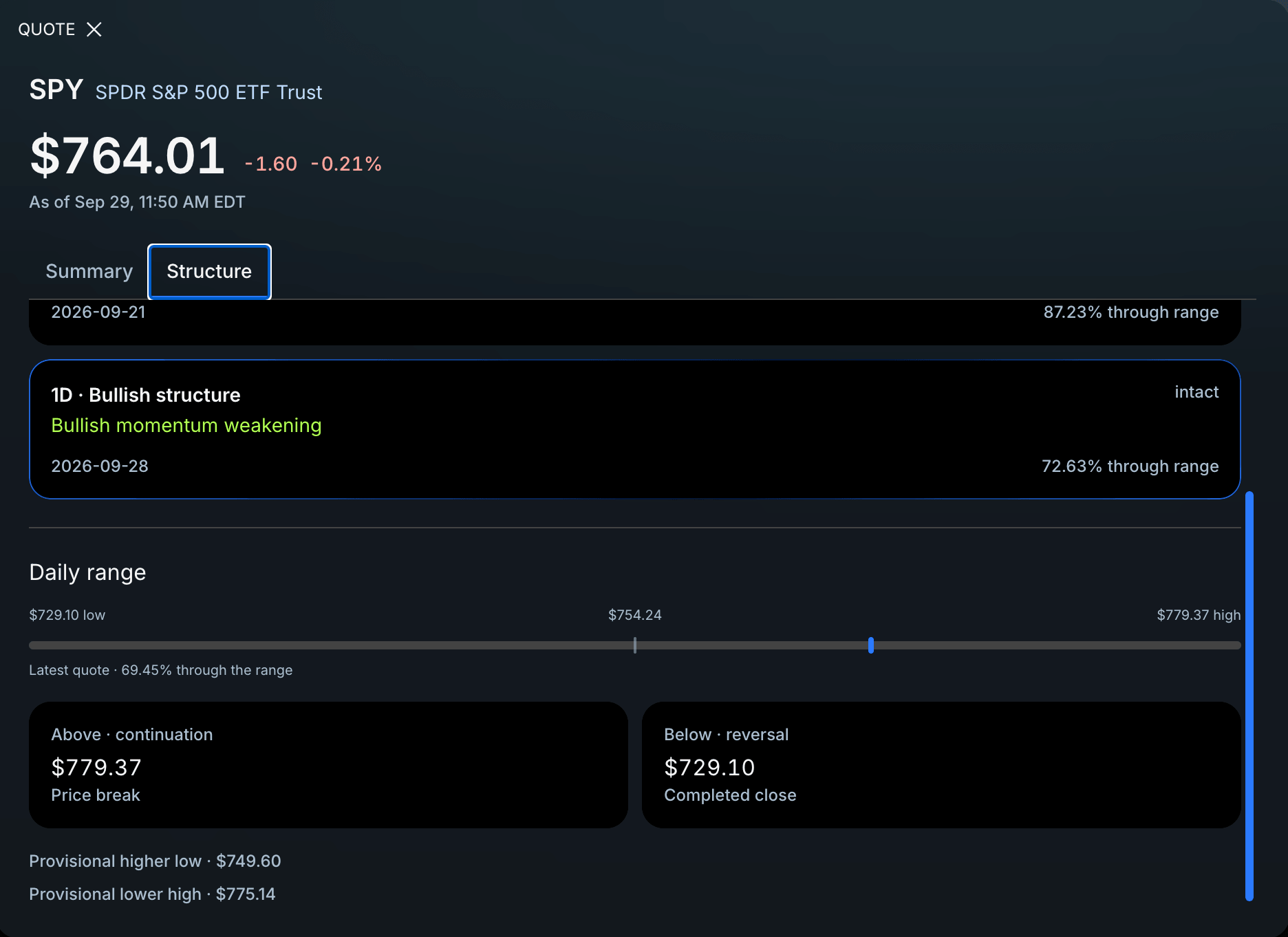
Open the futures chart first, then use SPY in Eden beside ES/MES, QQQ beside NQ/MNQ, IWM beside RTY/M2K, or GLD beside GC/MGC. Review structure, momentum, P-Trans, N-Trans, and expected-move targets. Set the executable entry, stop, and size on the futures chart.
Eden publishes options-derived levels on US optionable stocks and ETFs—not futures contract data or CFD quotes. The related ETF is a context map, not a substitute price.
Common FundedNext failure modes
- Applying Rapid’s no-DLL rules to Legacy or Bolt.
- Treating 40% consistency as permission for exactly 40% without buffer.
- Forgetting the 3:10 PM CT close requirement.
- Mixing CFD Stellar percentages with Futures rules.
- Relying on an older Flex summary without checking account status.
Frequently asked questions
How hard is it to pass FundedNext?
Difficulty depends on the model. Rapid removes challenge consistency and a daily loss limit, while Legacy and Bolt use consistency and additional loss controls. CFD Stellar accounts use separate percentage-based objectives.
How fast can you pass FundedNext?
Futures Rapid can be completed in one trading day if every objective is met. Legacy, Bolt, and CFD Stellar models have their own minimum-day and phase requirements, so the selected dashboard is authoritative.
What happens if you break FundedNext’s drawdown rule?
Reaching a maximum-loss boundary breaches the account. A daily-loss breach also matters on models that include one, while Rapid has no daily-loss limit in the challenge.
What tools help with a FundedNext challenge?
Use FundedNext’s dashboard for official limits and Eden to plan related ETF context, entries, stops, and possible targets. Eden does not guarantee a pass or publish futures-contract levels.
Verify availability in FundedNext’s current product overview, then apply the full evaluation-planning method.