
Key takeaways
- Apex currently sells Intraday Trailing and End-of-Day Trailing evaluations across Tradovate, Rithmic, and WealthCharts—not separate Rithmic and Tradovate rule families.
- The Intraday threshold follows peak equity, including unrealized profit; EOD drawdown updates after the session.
- Current evaluations have no consistency objective and no minimum days.
- Rules checked against Apex's help center and pricing page on October 24, 2026.
To pass the Apex challenge, know exactly when the trailing threshold moves. The common failure is a profitable open trade lifting the Intraday threshold, followed by a reversal that gives the open profit back.
Use the complete evaluation-planning guide for personal risk limits, then match that plan to the Apex model below.
Current Apex evaluation lineup
| Size | Profit target | Trailing drawdown | Max minis / micros |
|---|---|---|---|
| $25K | $1,500 | $1,000 | 4 / 40 |
| $50K | $3,000 | $2,000 | 6 / 60 |
| $100K | $6,000 | $3,000 | 8 / 80 |
| $150K | $9,000 | $4,000 | 12 / 120 |
These values apply to the current Intraday and EOD evaluation families. The difference is timing. Intraday drawdown follows peak equity in real time. EOD drawdown is recalculated after the trading day. EOD accounts also have soft daily loss limits of $500, $1,000, $1,500, and $2,000 respectively.
The evaluations are one-time purchases with 30 days of access, no minimum trading days, and no evaluation consistency rule. A qualified account must be activated within seven days. Current offerings stop at $150K; older articles describing $250K, $300K, static, monthly, or seven-day evaluations refer to legacy products.
Platform differences that still matter
Tradovate, Rithmic, and WealthCharts are execution/data routes within the current models. They do not create different target tables. On Intraday evaluations, Apex says the Rithmic and WealthCharts threshold stops trailing once it reaches the target balance, while Tradovate continues trailing. Verify that behavior in the checkout and dashboard for the exact account selected.
Apex drawdown math
On a $50K Intraday evaluation, the $2,000 threshold starts at $48,000. If peak equity reaches $51,200, the trailing floor rises with that peak. A reversal can therefore shrink the remaining cushion even if the trade never closed at the high.
There is no evaluation consistency cap to calculate. The practical pace calculation is still useful:
| Size | Target | Four-day pace | Eight-day pace |
|---|---|---|---|
| $25K | $1,500 | $375 | $187.50 |
| $50K | $3,000 | $750 | $375 |
| $100K | $6,000 | $1,500 | $750 |
| $150K | $9,000 | $2,250 | $1,125 |
The pace is a ceiling, not a quota. If the setup is absent, no trade is the correct trade.
Performance Account rules are a new stage
After passing, the Performance Account introduces payout conditions. Apex’s current 50K example shows a five-trading-day payout path, a 50% consistency requirement, a reduced 4-mini/40-micro cap, and a daily loss rule. Do not apply old “30% consistency” summaries automatically; confirm the current PA dashboard and selected purchase path.
Use Eden without pretending SPY is ES
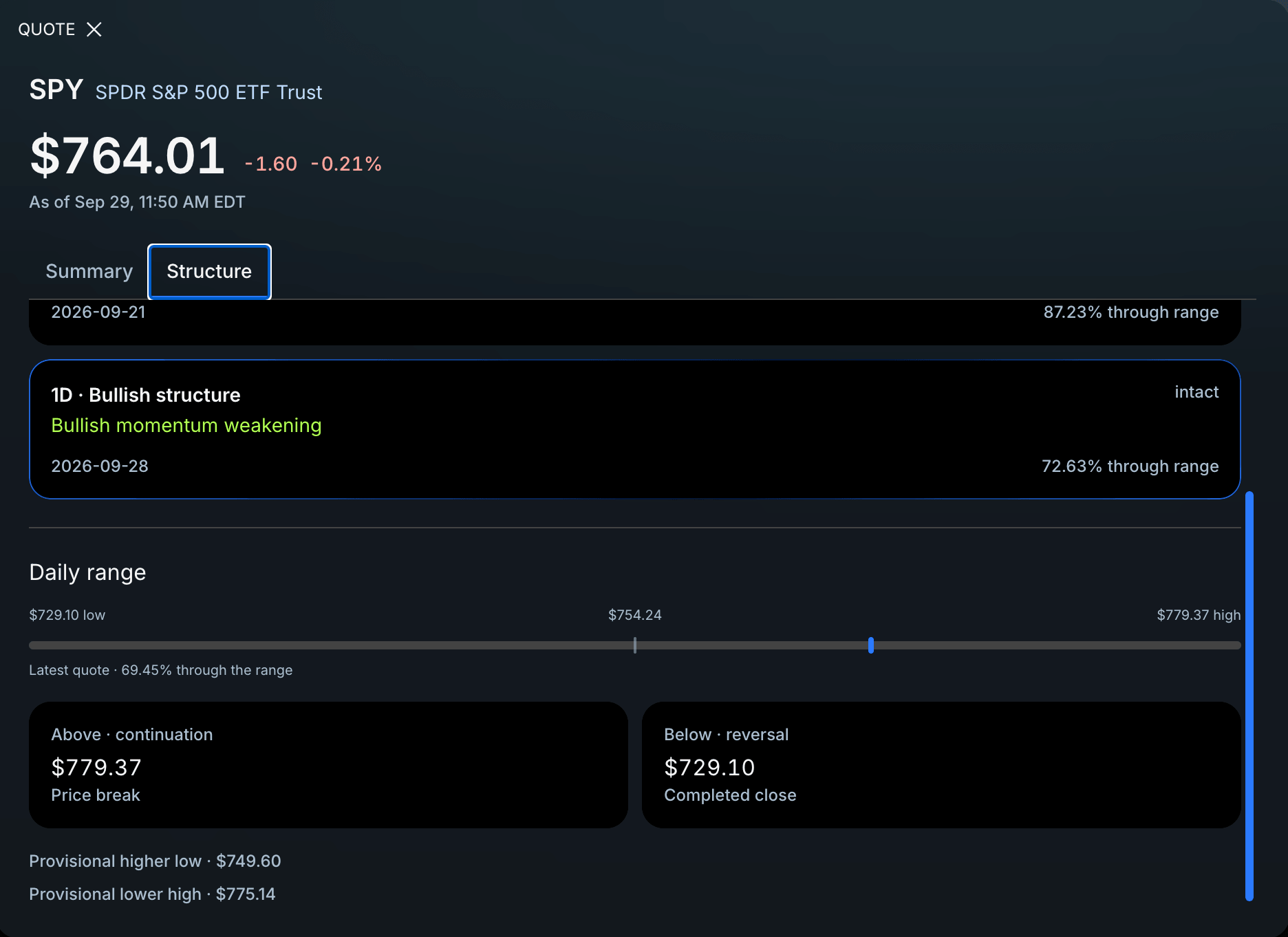
Open the futures chart first. Use SPY in Eden for ES/MES context, QQQ for NQ/MNQ, IWM for RTY/M2K, and GLD for GC/MGC. Mark Eden’s structure, momentum, P-Trans, N-Trans, and expected-move targets. Then define the futures entry, stop, and size on the futures chart.
Eden publishes US stock and ETF options-derived levels. It does not publish futures-contract levels. Related ETFs can support the map, but the futures chart controls execution.
Common Apex failure modes
- Letting open profit lift the Intraday threshold, then giving the move back.
- Choosing Intraday without understanding the platform-specific threshold lock.
- Trading the maximum contract allowance instead of sizing from the stop.
- Carrying old monthly or legacy rules into a current one-time evaluation.
Frequently asked questions
How hard is it to pass the Apex challenge?
The difficult part is protecting a trailing drawdown that is smaller than the profit target. The Intraday model reacts to new equity highs during the session, while the EOD model updates from end-of-day performance.
How fast can you pass Apex?
Apex’s current Intraday and EOD evaluations have no minimum trading-day requirement, so one-day completion is possible. The evaluation access period is 30 days, and speed does not reduce the drawdown risk.
What happens if you break Apex’s drawdown rule?
Touching the trailing threshold fails the evaluation. On an EOD evaluation, the separate daily loss limit is a soft pause, but the maximum drawdown remains the hard boundary.
What tools help with an Apex evaluation?
Use the Apex dashboard to monitor the live threshold and a planning tool for entries and exits. Eden can provide related-ETF context, but it cannot monitor the Apex account or guarantee a pass.
Confirm the model on Apex’s official Intraday evaluation rules or EOD evaluation rules. Then apply the full prop firm evaluation method.