An opening-range breakout is a trade setup. Options-derived levels are market context. The opening range tells you when price leaves the early-session high or low. Options levels can help you decide whether the breakout has room, where resistance or support may appear, and what would invalidate the plan.
Opening-range breakout in plain language
An opening-range breakout, often called an ORB, trades a move above or below the high and low formed during a chosen period after the market opens.
The exact range may use the first 5, 15, or 30 minutes depending on the strategy. The setup should define its range before the breakout occurs.
What options-derived levels show
Options-derived levels identify prices that may matter because options positioning is concentrated nearby. They can provide context before and after the opening range forms, but they do not define the ORB trigger.
Different jobs
| Decision | Opening range | Options-derived levels |
|---|---|---|
| Defines a breakout trigger | Yes | No |
| Shows early-session high and low | Yes | No |
| Adds options-positioning context | No | Yes |
| Helps assess overhead or downside room | Only through price structure | Key levels and potential targets can add context |
| Guarantees follow-through | No | No |
Use options levels before taking the breakout
Before entering, ask:
- Is a nearby options-derived level directly beyond the range?
- How much room remains to the next potential target?
- Would a failed breakout back inside the range invalidate the setup?
- Does the opposite side of the opening range create too much risk?
A breakout can be technically valid and still offer poor remaining room.
A combined workflow
- Choose the opening-range length before the session.
- Mark the range high and low.
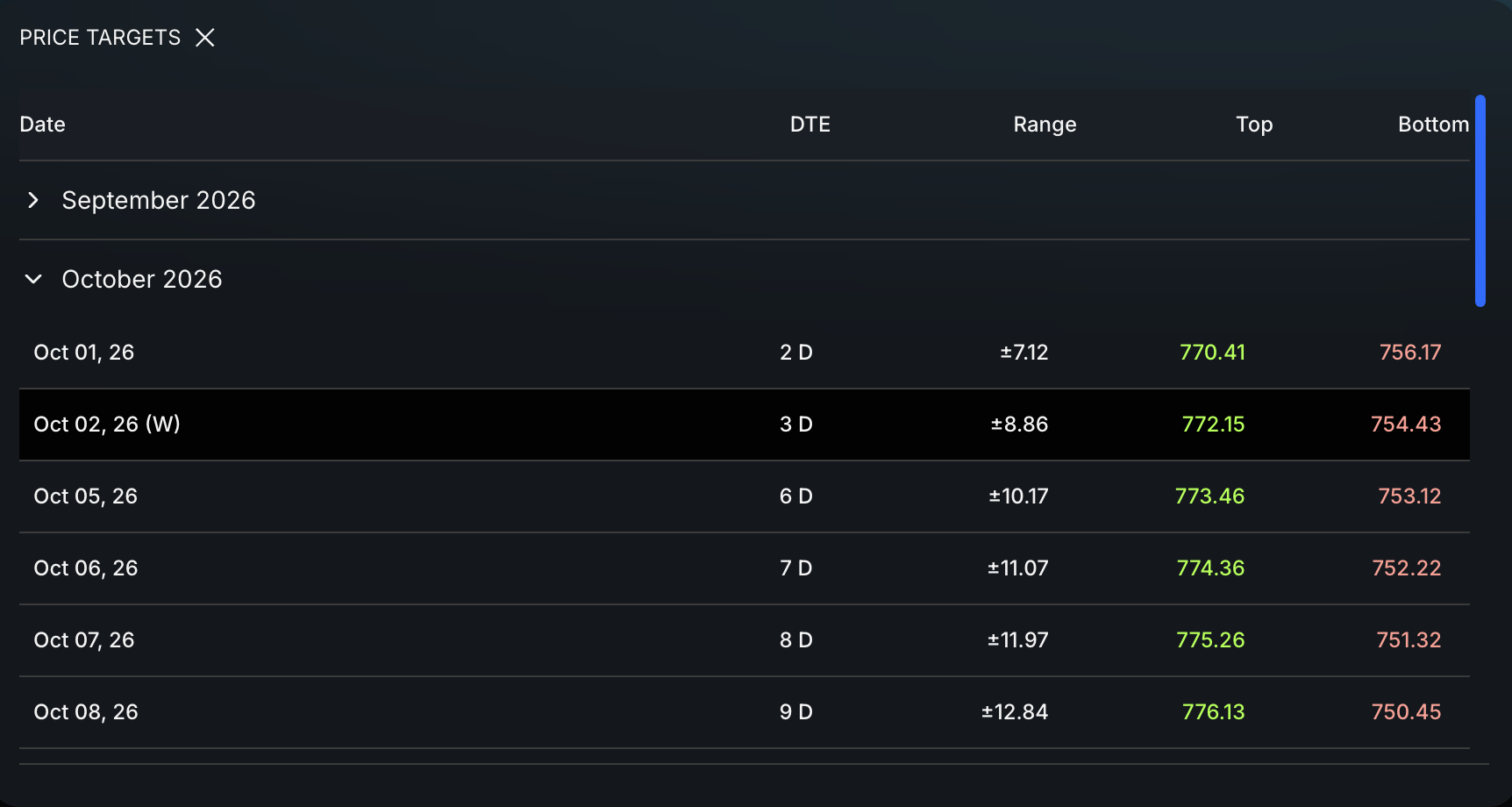
- Enter the ticker in Eden and review nearby key levels and price targets.
- Wait for the ORB condition required by your strategy.
- Compare the entry with the next options-derived decision area.
- Define invalidation and skip the trade if required risk is larger than the remaining opportunity under your rules.
An illustrative example
Suppose the 15-minute range high is $100 and an Eden level sits near $100.30, with a potential target at $102. A breakout and successful retest of $100 may still leave useful room. If the nearest potential target were $100.20, the same breakout might offer little space after entry.
This example is illustrative and not a recommendation.
When ORB alone may be enough
The opening range may be enough when your strategy has tested entry, stop, and exit rules and nearby market context does not change the decision. More levels should not be added simply to make the setup look sophisticated.
When options levels may help
They may help when breakouts repeatedly run into unseen resistance, when targets feel arbitrary, or when you need another way to judge remaining room.
For late breakouts, read Stop Chasing Trades.
Frequently asked questions
Do options levels predict whether an ORB will work?
No. They provide context around the setup. Price still must confirm and every breakout can fail.
Should the opening-range low always be the stop for a long breakout?
Not automatically. Invalidation depends on the strategy, range size, and price behavior. Define it before entry.
Can an options level become an ORB target?
It can be a potential decision area when it sits beyond the range. It is not a guaranteed destination.
Takeaway
The opening range defines the setup. Options-derived levels help measure the path beyond it. Use the range for the trigger and use context to judge invalidation, remaining room, and potential targets.