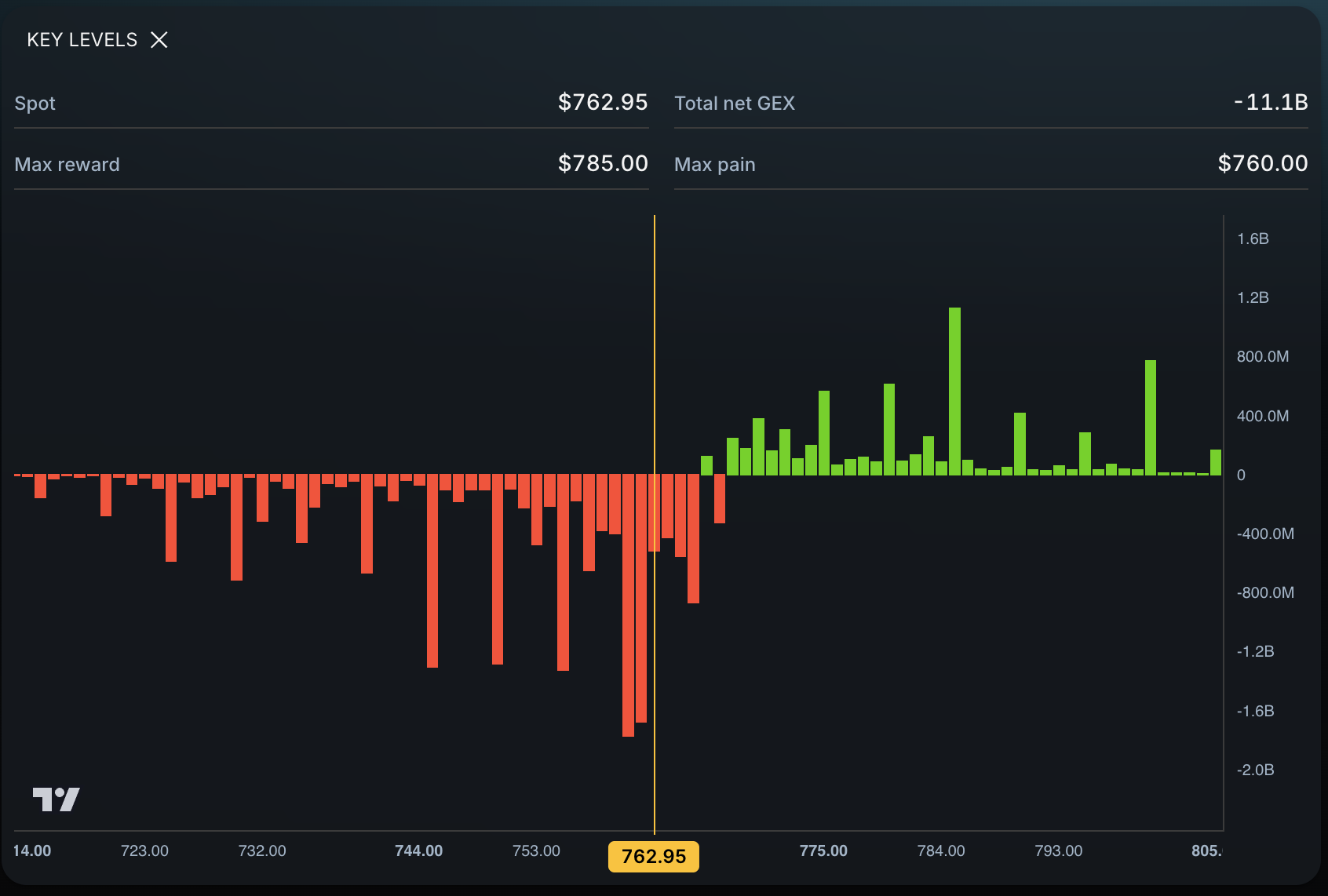
VWAP tells you where the session’s volume-weighted average price sits. Options-derived levels point to prices where options positioning may affect market behavior. Day traders can use both because they answer different questions.
VWAP in plain language
VWAP means volume-weighted average price. It averages the session’s traded prices while giving more weight to prices with more volume.
Traders often use VWAP to judge whether price is trading above or below the session’s average and to watch for holds, reclaims, or rejections around that line.
VWAP changes as new trades occur. It is a session reference, not a guaranteed support or resistance level.
What options-derived levels show
Options-derived levels use options-market context to identify prices that may matter because positioning and hedging are concentrated nearby. Eden presents nearby key levels with current price and potential price targets.
These levels may sit above, below, or near VWAP. They do not replace price confirmation.
VWAP vs. options-derived levels
| Question | VWAP | Options-derived levels |
|---|---|---|
| What is the session’s volume-weighted average? | Core purpose | Not its purpose |
| Where may options positioning matter? | Does not directly answer | Core context |
| Does it update during the day? | Continuously with session trades | Current analysis can refresh during the session |
| Can it support entry conditions? | Yes, through holds, reclaims, and rejections | Yes, through reactions around key levels |
| Does it provide a guaranteed signal? | No | No |
When VWAP should come first
VWAP may be the main reference when your strategy is specifically built around the session average, trend acceptance, or mean reversion. If you have tested clear VWAP rules, adding another level should not override them without evidence.
When options-derived levels add value
Options levels can help when VWAP alone does not show the next likely decision area or target. They can also explain why price reacts away from the session average near a major options-related price.
A combined workflow
- Put VWAP on the intraday chart.
- Enter the ticker in Eden.
- Note the nearest options-derived levels and potential targets.
- Remove distant lines that do not affect the current trade.
- Decide which reaction matters: a VWAP reclaim, a level hold, or alignment between both.
- Define invalidation and remaining room before entering.
If VWAP and an Eden level sit near each other, the overlap may deserve attention. It still does not guarantee a reaction.
An illustrative example
Suppose price reclaims VWAP while an options-derived level sits just overhead. The reclaim shows improving session position, but the nearby level may limit remaining room. A trader can wait for price to clear and hold both areas or use the overhead level as the first decision point.
This is an educational example, not a recommendation.
Which should you follow?
Follow the rule set you understand and have tested. Use VWAP for session-average context. Use options-derived levels for another map of possible reaction areas and targets. Do not switch between them only because one gives the answer you want.
For a wider comparison, read Which Trading Level Matters Most: VWAP, Volume Nodes, or Gamma Levels?.
Frequently asked questions
Is VWAP support when price is above it?
Not automatically. Price must show that buyers are defending or reclaiming the area under the rules of your setup.
Are options-derived levels more predictive than VWAP?
Neither should be treated as a prediction. They describe different context and both can fail.
Should I enter when VWAP and an options level overlap?
An overlap can identify an area worth watching. Wait for the price reaction required by your strategy and define invalidation first.
Takeaway
VWAP shows the session’s weighted average. Options-derived levels show where options positioning may matter. Use each for its own job, then let price confirm the trade.