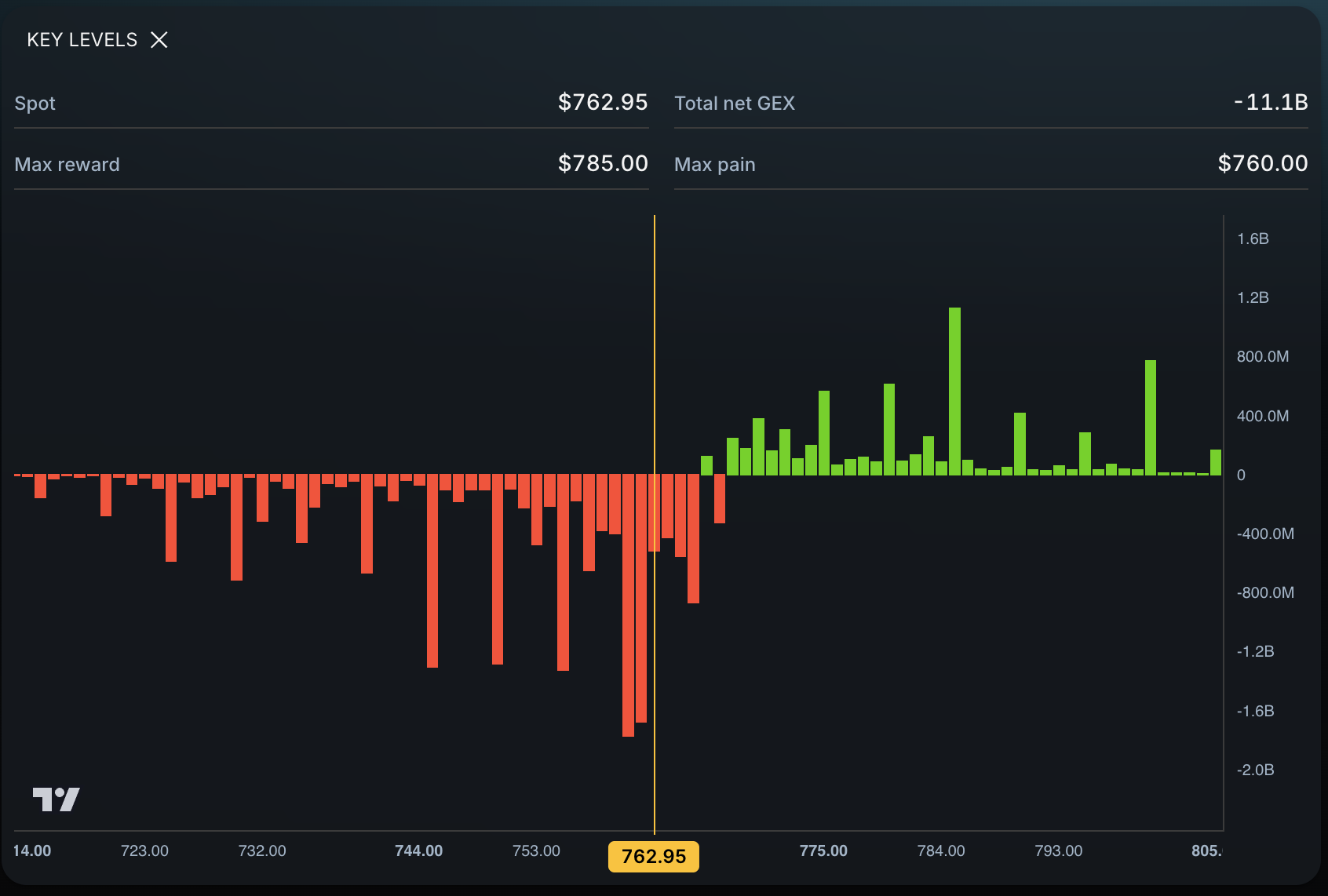
Use premarket levels to prepare decisions before the opening rush. Use live intraday levels to check whether that map still fits after price, volume, and options activity begin changing. A day trader usually needs both preparation and updates, not a choice between them.
What premarket levels do well
Premarket work gives you time to think before money is at risk. You can mark:
- the prior day’s high, low, and close,
- overnight high and low,
- gaps and visible swing areas,
- the opening location inside the recent range,
- and the first possible target above and below price.
This map helps you avoid making every decision during the first fast candles.
Where a morning map can fail
The open brings new information. Price may gap through a level, reject it immediately, or build a range somewhere else. Options activity and the importance of nearby strikes can also change during the session.
A level drawn at 8:00 a.m. is still useful as a reference, but it should not remain a command after the market shows different behavior.
What live intraday levels do well
Live levels help answer:
- Has the nearest decision area changed?
- Is price now closer to a different target?
- Did the morning level hold, fail, or become less relevant?
- Does the current entry still leave enough room?
- Should an old line be removed from the plan?
The purpose is not constant adjustment. It is preventing a stale map from controlling a new market.
Static levels vs. levels that refresh
A static level is a saved price that stays on the chart until you change it. A refreshing level can change as the underlying market context changes.
Static levels are useful when they represent fixed references such as yesterday’s high or an overnight low. They are also easy to plan around because the number does not move.
Refreshing levels are useful when the source itself changes during the trading day. Their value is not that every update demands action. Their value is showing that the current map may no longer match the morning snapshot.
Use a static line as long as its reason remains valid. Revisit a refreshing source at meaningful decision points: before entry, after a major break, or when the session structure changes.
Premarket vs. intraday at a glance
| Decision | Premarket levels | Live intraday levels |
|---|---|---|
| Main use | Prepare scenarios before the open | Recheck the map as conditions change |
| Emotional benefit | Reduces rushed decisions | Reduces attachment to stale assumptions |
| Best inputs | Prior and overnight structure; latest available context | Current-session price and updated market context |
| Main risk | Treating an old level as permanently valid | Reacting to every update and abandoning the plan too quickly |
A combined day-trading routine
Before the open
Choose a small number of levels. For each one, write the reaction required for entry, logical invalidation, and next potential target.
After the first range forms
Check whether price respected the morning map. Do not add lines simply because the open was volatile.
Before entering
Compare current price with the latest nearby level and target. If the entry now offers little remaining room, skip or wait for a new setup.
During the trade
Use the planned invalidation and target. Rechecking levels should provide context, not become an excuse to widen risk.
How Eden supports both stages
You can build a manual morning map. Eden shortens the routine by placing current price, nearby key levels, possible invalidation context, and potential price targets in one ticker view.
Eden’s levels refresh throughout the trading day, allowing you to revisit the map as market conditions change. A refresh does not mean every displayed value will change, and it does not require a new trade decision.
Check the ticker before the session, then revisit it as the day changes. Eden does not decide when an update cancels your setup. The trader still interprets the reaction and follows risk rules.
For a SPY- and QQQ-specific morning process, read How to Find SPY and QQQ Support and Resistance.
Frequently asked questions
Are premarket levels still useful after the open?
Yes, when price continues to respect them or they remain widely watched references. Their importance should be judged by current price behavior.
How often should I refresh intraday levels?
Refresh at meaningful decision points rather than reacting to every small move: before entry, after a major break, or when the session structure changes.
Should I move my stop whenever a level updates?
No. A stop or invalidation belongs to the trade plan. Do not widen risk simply because new information appears.
Is a static morning snapshot enough?
It can be enough for a fixed price-action plan or a quiet session. If the market moves sharply or the surrounding context changes, recheck the map before taking a new trade.
Do Eden’s levels update after the market opens?
Yes. Eden’s levels refresh throughout the trading day so you can revisit the map as conditions change. Not every value necessarily changes with each refresh.
Takeaway
Premarket levels prepare the plan. Live intraday levels test whether the plan still matches the market. Use the morning for calm decisions and the session for deliberate updates.