An evaluation trade should not begin with “How much can I afford to lose?” It should begin with “What market evidence makes this setup wrong?” The account limit controls whether the trade fits. It does not create the invalidation.
Start with the futures setup
Write four lines before entry:
- Setup: What pattern or condition exists?
- Trigger: What must futures price do before entry?
- Invalidation: What observable price behavior proves the thesis failed?
- Target: Where is the next reasonable decision area?
“Down $500” is an account result, not market invalidation. “ES accepts below the reclaimed range” is market evidence.
Add the related ETF map
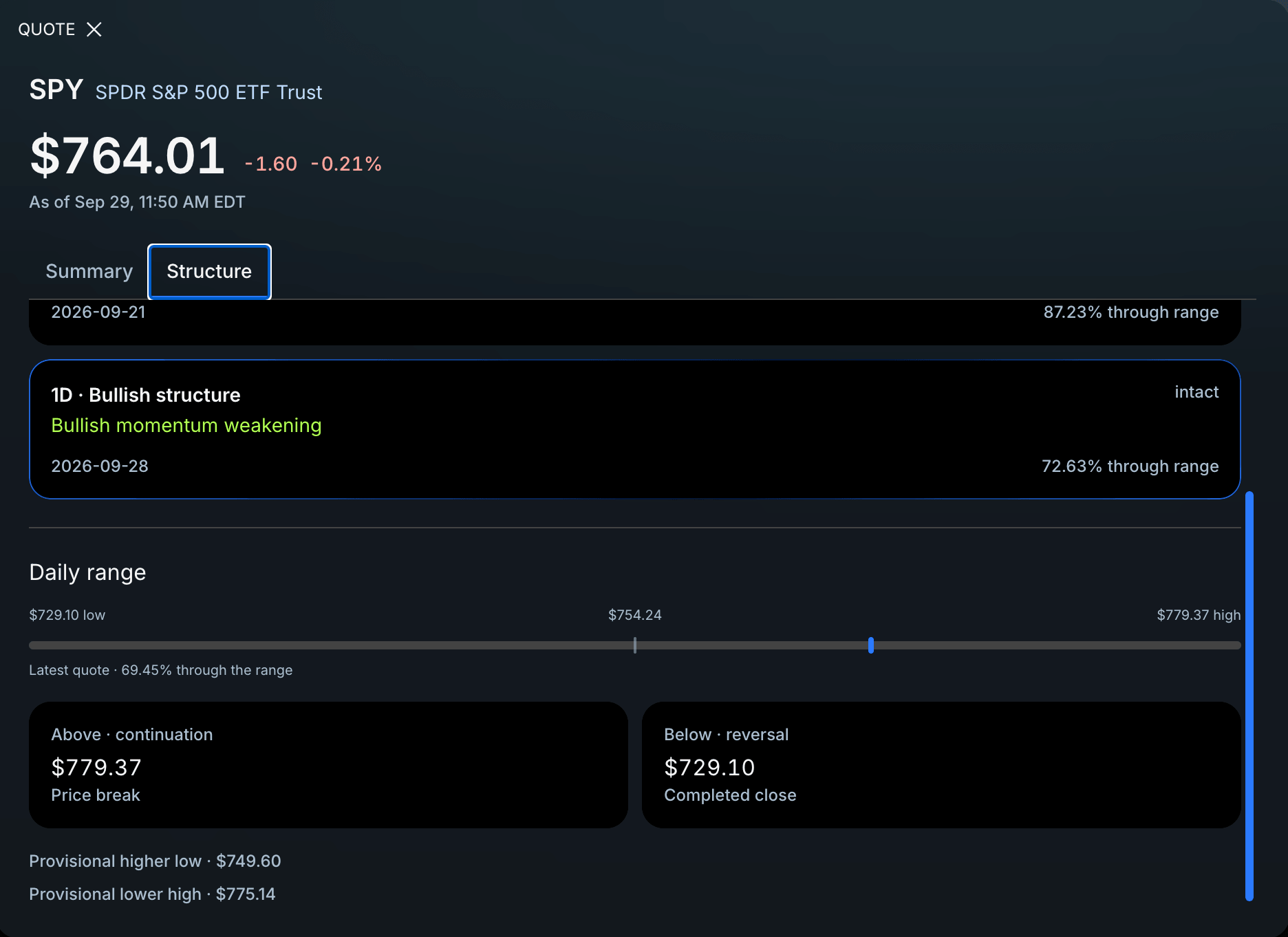
Open the related ETF in Eden and review key levels and potential targets. Use SPY beside ES, QQQ beside NQ, or GLD beside GC. Then return to the futures chart.
ETF context may show that the related market is still testing an area, that little room remains to a target, or that waiting makes sense. It cannot set the futures stop for you.
ETF and futures prices are not interchangeable. Define the actual trade on the futures chart. See the complete futures/ETF workflow.
Fit size to invalidation
Once the futures invalidation is known:
- Measure the futures distance from entry to stop.
- Apply the contract’s tick or point value.
- Compare the resulting exposure with the evaluation’s current rules.
- Reduce contract size, improve the entry, or skip the trade if it does not fit.
Do not squeeze the stop closer only to preserve larger size.
Separate three limits
- Market invalidation: where the thesis fails.
- Trade loss: the money exposed at the chosen size.
- Evaluation limit: the provider’s current account rule.
All three must fit before entry. Rules vary by provider and can change, so use the agreement and dashboard for the evaluation you actually trade.
If the stop keeps getting hit
Review entry timing before making every stop wider. A three-point stop-out that later ran can come from an early entry, normal noise, or a valid loss. If larger size changes your behavior, read the sizing-up curse.
Frequently asked questions
Is invalidation the same as a stop order?
Not exactly. Invalidation is the market evidence that ends the thesis. The stop order is one method of controlling risk around that evidence.
Should evaluation limits decide the stop location?
They decide whether the trade fits. They should not turn an arbitrary price into market invalidation.
Can an ETF level be futures invalidation?
It can add context, but the executable invalidation belongs on the futures chart.
Takeaway
Define what makes the setup wrong, then decide whether the required stop and size fit the evaluation. When they do not fit, skipping is part of the process.