You were stopped by three points, then price ran to the target. That does not automatically mean the stop needed three more points. The entry may have been early, the stop may have sat inside normal noise, or the setup may simply have lost before the market later moved.
Review the trade without moving the answer
Freeze the chart at entry. Ask:
- What exact futures behavior made the setup valid?
- What evidence would have made it wrong?
- Was the stop placed at that invalidation or at a comfortable dollar amount?
- Did the entry occur before the level finished testing?
- Did position size force a stop tighter than the setup allowed?
A stop should not be widened after the fact merely because the later move worked.
Stop distance and invalidation are different
“Three points” describes distance. “A completed close below the reclaimed range” describes invalidation. A strategy needs the second statement before contract size can be chosen.
Read the full futures-evaluation invalidation framework and the broader guide on placing stops with support and resistance.
Add SPY context to an ES review
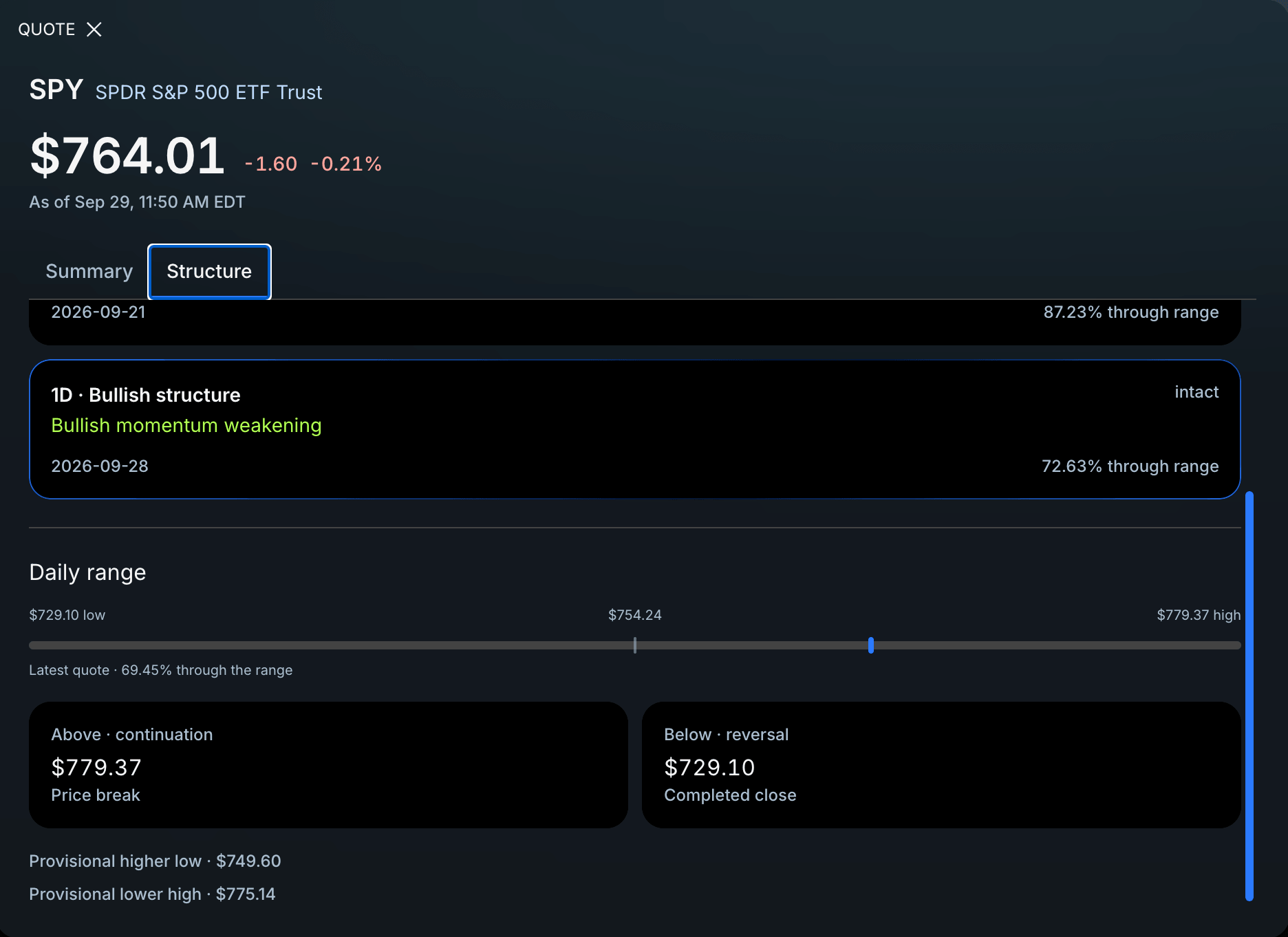
For an ES trade, open SPY in Eden and review nearby key levels. If SPY was still testing support while ES entered early, the review may show a timing problem. If SPY clearly failed its area and ES stopped, the original loss may have followed the plan.
SPY and ES respond to the same underlying equity market, but their prices are not interchangeable. Use SPY options levels as additional context and define the actual trade on the ES chart.
Continue with the ES trader’s guide to SPY options levels and VWAP or SPY key levels for ES stop context.
The correct answer may be smaller size
If structural invalidation is farther away than the account or evaluation allows, the choices are smaller size, a different entry, or no trade. Moving the stop inside normal noise to preserve larger size changes the setup.
Frequently asked questions
Should I add three points to every future stop?
No. A universal distance ignores volatility, structure, contract value, and strategy.
Was the trade good if price later hit the target?
Not necessarily. Judge the entry and risk from information available at the time, not the later outcome.
Can Eden choose the stop?
No. Eden adds market context. The trader defines futures invalidation and risk.
Takeaway
Review the trigger, invalidation, and size—not only the three points between exit and reversal. Sometimes the correct loss is the one that followed a complete plan.