
There is no single best stock trading strategy for everyone. There is a best strategy for a specific job, a specific amount of time, and a specific amount of risk you can live with.
The best stock trading strategies are the ones that let you put money to work in the stock market without sitting at the charts. That usually means swing trading and position trading, with a plan written before you enter. Day trading can work for a full-time trader. For anyone who cannot spend hours at the charts every trading day, day trading usually fails on time first, and on risk second.
The set-it-and-forget-it approach in this guide looks for larger expansions on weekly and monthly timeframes instead of small intraday moves.
Information and Eden product behavior checked November 5, 2026.
Key takeaways
- Best strategy means a strategy that has a clear entry, a clear exit, and a clear stop based on the option dynamics and macro market structure.
- Swing trading and position trading fit a longer timeframe better than day trading or scalping. Day trading and scalping usually do not, because they require hours at the screen every trading day.
- Stock trades are directional. Identify market structure first, then momentum, then mark your entry, your price target, and your invalidation.
- For 2027, the best trades are companies that are undervalued, down more than 50% from all-time high to swing low, with a lot of growth in earnings, using option premiums to find entry, exit, and invalidation points.
- A strategy is not a ticker pick. It includes a level, confirmation, invalidation, target, and position size, written before entry.
- Time is the cost most traders ignore. A strategy that makes a small profit after 1,300 hours at the charts is a worse strategy than a strategy that makes a similar profit after a few hours of check-ins.
- The longer the time horizon, the greater the odds of success.
What is a stock trading strategy?
What is stock trading? Stock trading is a directional style of trading. Price can only go up or down.
A stock trading strategy is a set of rules that lets the trader know when to enter, when to exit, how much to risk, and when the idea is wrong. Without those rules, you do not have a strategy. You have a guess, and you will change the guess every time price moves against you.
Your first job is to identify momentum before choosing, before clicking buy.
A complete swing stock trading strategy has to answer these five questions, before entry:
- Is market structure on the weekly or monthly time frame intact? Is the long-term uptrend intact? You could short, so this applies to both sides, but this is the baseline for an uptrend.
- Is momentum returning on your side? Is it bullish momentum? You could use the BX Trender indicator as a tool.
- Has the option market defined an entry, when to go long or short, where does it become wrong, and what are the price targets based on the option market?
- When it comes to risk, how much are you willing to risk, aka lose, on this trade?
- If a strategy cannot answer these questions, it is not ready to be traded.
Best stock trading strategies compared by holding period and time needed
| Strategy | Time needed | Holding period | Best for |
|---|---|---|---|
| Scalping | Constant screen time, many trades per day | Seconds to minutes | Full time, experienced traders with a specific edge |
| Day trading | Hours at the screen, every trading day, 9:30AM to 4PM | Minutes to hours, flat by close | Full time traders only |
| Short-term swing trading | Check daily | Days to weeks | Traders who want a shorter swing, with a daily check-in |
| Swing trading | Check once or twice a week, about 10 minutes each | Days to months, Ruben’s own best style is 3 to 6 month holds | Traders who want a plan, not a second job at the charts |
| Trend following and momentum | Check weekly, follow the trend, exit when momentum turns | Weeks to months | Traders who want to ride a move, not predict a reversal |
| Position trading | Check weekly, set alerts, manage the position | 6 to 12 months to play out | High income earners putting money to work over a longer horizon |
| Value, undervalued companies | Research up front, then hold and check periodically | Months to years | Traders who want to buy a business at a discount, not a chart pattern |
This table is ordered from the strategy that requires the most amount of time at the charts to the one that requires the least amount of time. Scalping and day trading are at the top so you can see what they look like, and how they compare to swing and position trading. They are included as the foil, not as a recommendation for a longer timeframe plan.
Swing trading: the set-it-and-forget-it strategy
Swing trading is the core strategy in this guide. The set-it-and-forget-it version works like this:
- Find an undervalued ticker with supportive monthly and weekly structure, strong earnings growth, and momentum turning up.
- Mark two or three support and resistance levels and give each a job: entry, target, or invalidation.
- Write the confirmation you need. Wait for price confirmation instead of predicting every touch.
- Set the line where the idea is wrong and size the trade from that loss.
- Run the sleep test: if the position moves against you overnight, is the planned loss still acceptable?
Then check the position once or twice a week instead of watching it all day. That is the whole point of the strategy, and it is the reason it fits a longer timeframe plan.
For a deeper comparison of workload and risk, read swing trading vs. day trading. To evaluate activity around a planned level, use the order flow trading guide.
Position trading: putting money to work over months
Position trading is slower, and that is a feature, not a bug, for a trader who wants a longer horizon. A practical five-step process is:
- Find undervalued tickers.
- Confirm weekly and monthly structure is still bullish and intact.
- Find tickers trading at a discount.
- Set entry, stop, and exit using option premiums.
- Use alerts, then return to your day job.
Automation here means alerts and a written plan, not automatic execution. Eden does not place trades and is not a broker.
For a beginner, big-timeframe position trades are the simplest starting point. They can take 6 to 12 months to play out and do not require frequent touching. That gives a new trader time to observe how price moves and how P&L reacts without turning the process into an all-day decision loop.
Trend following, value, and options-based swing
Trend following and momentum
Follow the direction price is already moving, enter on a pullback to a defined level, and exit when momentum turns or the trend breaks. The main failure is chasing after the move becomes obvious.
Value and undervalued companies
Buy a business at a discount, not merely a chart pattern. CELH is one example Ruben has used to explain a long-term thesis after a large decline. That is an example of a thesis, not a recommendation or guarantee. A value trade still needs an invalidation and target.
Options-based swing and LEAP options
A LEAP option can offer defined-risk participation without buying a full stock position. First estimate a dated target, then review strikes between current price and the target in roughly the 25-to-50-delta range. Prefer a contract where the gamma ramp begins before the target so the contract can respond to the intended move. The wrong strike or expiration can undermine an otherwise sound stock thesis.
Day trading and scalping: why they fail on time
Day trading is not a bad strategy in general. It is a bad strategy if you cannot spend hours at the charts every trading day. A beginner who starts with day trading is starting with the strategy that costs the most time.
In an example Ruben shared on November 4, 2026, a food vendor spent more than 1,300 hours day trading across 200-plus days for roughly $1,000 in profit, or about $0.77 per hour. Two swing trades produced roughly $2,000 with only a few hours of periodic check-ins over four months, equivalent to roughly $350 to $700 per hour of check-in time depending on the time estimate. The figures came from Ruben’s post and have not been independently verified; they illustrate time cost, not a typical return.
Scalping pushes the same conflict further: more trades, screen time, transaction costs, stress, and decisions.
The same time and risk conflict appears in evaluation accounts; the prop-firm challenge guide explains how a written daily loss limit and plan change that workflow without promising a pass.
How to choose the best stock trading strategy for you
Choose based on your time, capital, and risk floor—not excitement.
- How many hours can you honestly give trading each week?
- How much can you lose on one trade without losing sleep?
- What holding period fits your actual life?
- Can you describe your edge in one sentence?
- Can you write entry, confirmation, invalidation, target, size, and the sleep test before entry?
Most traders will land on the same answer: one swing or position strategy, done well, with a written plan, checked once or twice a week.
How Eden fits, and where it does not
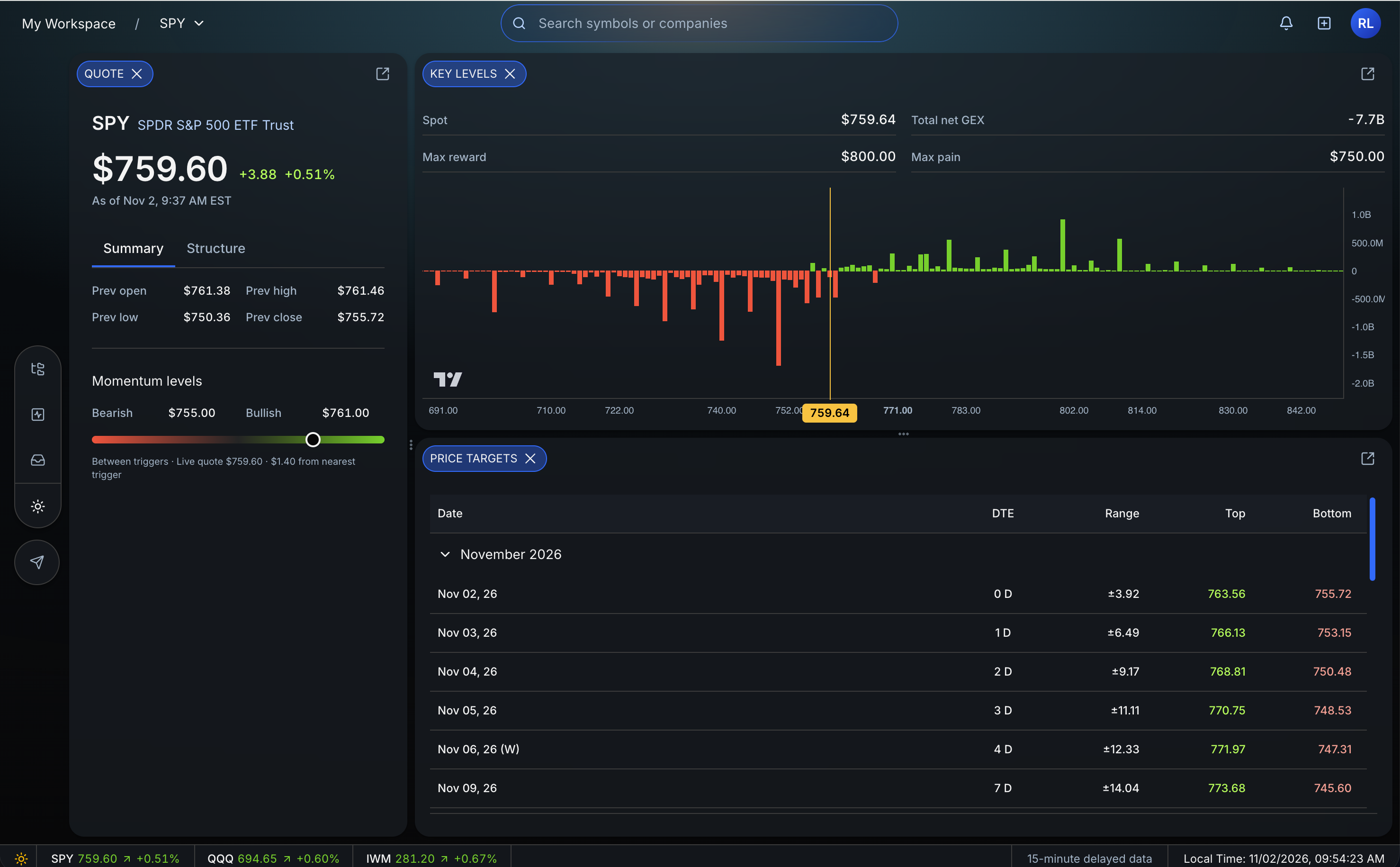
Eden is a planning layer, not a strategy or broker. It reads the options market to surface entries, key levels, and potential dated upside and downside targets in less than 10 seconds across 6,000+ US optionable tickers.
For swing and position trading, Eden can help you:
- Identify the swing high and low and review whether structure is bullish or bearish.
- Map an entry, stop, and exit targets before entering.
- Use P-Trans and N-Trans as bullish and bearish transition references, not guarantees.
- Review SPY as a planning proxy for /ES, QQQ for /NQ, and GLD for gold context.
Eden does not place trades, publish futures contracts directly, provide a DOM or footprint, or guarantee a return.
Frequently Asked Questions
What is the best stock trading strategy?
There is no single best stock trading strategy for everyone. Best depends on your time, capital, and risk floor. For a trader who wants a plan checked once or twice a week, the best strategies are usually swing trading and position trading, with a written plan.
What is the best stock trading strategy for beginners?
Start with big-timeframe position trades that can take 6 to 12 months to play out and do not require frequent touching. This helps a beginner learn how price and P&L react without overcomplicating the trade. Start with one strategy and one position trade at a time, paper trade it first if needed, and risk only an amount whose loss at invalidation is acceptable.
What are the best stock trading strategies for 2027?
For 2027, focus on companies that are undervalued, have retraced more than 50% from the all-time high to the swing low, show strong earnings growth, and have option premiums that help define entry, exit, and invalidation points.
What is the best stock trading swing strategy?
Use a written set-it-and-forget-it plan: identify supportive structure and momentum, mark two or three levels, require confirmation, define invalidation, and check the trade once or twice a week.
Are day trading strategies best if you cannot watch charts all day?
Absolutely not. Day trading strategies require hours at the screen every trading day. If you cannot spend that time at the charts, the time cost eats the return, as in the food vendor example above. A full-time trader can day trade. A trader who cannot watch charts all day usually cannot, without the time cost eating the return.
How many stock trading strategies should I use?
Use one strategy for the next year until entry, stop, exit, patience, and risk become mechanical. One strategy done well is better than five done badly. Trade it consistently, one swing trade at a time, before adding a second strategy.
Do I need Eden if I already use TradingView?
Yes. Eden is not a replacement for TradingView. TradingView shows the chart and levels you draw by hand, while Eden reads the options market to give you entries, targets, and a full plan in less than 10 seconds for any US optionable ticker.
Takeaway
The best stock trading strategy fits your life, not your appetite for excitement. That usually means swing trading or position trading, with a written plan, entry, target, and the line where you are wrong, checked once or twice a week.
Mark the level, define its job, require confirmation, set the line where the idea is wrong, and size the loss before entry.