Risk is the amount you are willing to lose if the swing trade fails. It is not the total amount used to open the position. Decide account risk first, find the price that invalidates the trade, and calculate position size last.
Think of risk as the amount of water you are willing to spill. Position size is the size of the bucket. A large bucket can still spill only a little when the exit is close, while a small bucket can spill everything when there is no exit plan.
What percentage should you risk on a swing trade?
One simple framework is:
| Risk style | Maximum planned account loss per trade |
|---|---|
| Conservative | About 0.5% |
| More aggressive | About 1% |
| Extremely aggressive | About 2% |
These percentages are examples, not promises of safety. A new trader may choose less. A trader should never risk money needed for bills, emergency savings, or other financial goals.
For a $100,000 account, those limits would be:
| Risk style | Calculation | Maximum planned loss |
|---|---|---|
| Conservative | $100,000 × 0.5% | $500 |
| More aggressive | $100,000 × 1% | $1,000 |
| Extremely aggressive | $100,000 × 2% | $2,000 |
The percentage is an individual choice. It sets the loss limit for the trade before the trader calculates how many shares to buy.
The 2% level is extremely aggressive because several losses can reduce the account quickly. Five full 2% losses would reduce the starting account by almost 10% when each new loss is calculated from the smaller balance.
Risk is different from position size
Suppose a trader has a $100,000 account and uses the conservative 0.5% risk limit. The most the trader plans to lose is $500.
Now imagine an illustrative Pepsi trade:
- Planned entry: $129.27 per share
- Stop or invalidation: $127.20 per share
- Risk per share: $129.27 − $127.20 = $2.07
- Maximum account risk: $500
- Basic position size: $500 ÷ $2.07 = 241.54 shares
- Rounded position size: 241 shares
- Position cost: 241 × $129.27 = $31,154.07
- Planned loss at the stop: 241 × $2.07 = $498.87
The trader uses about $31,154 to open the position but plans to lose about $499 if the exit fills at $127.20. The amount spent on shares is the position size. The entry-to-stop loss is the account risk.
These Pepsi prices are an arithmetic example, not a current quote or trade recommendation.
Find invalidation before sizing the trade
Do not choose a random stop just to make the position larger. Invalidation should come from the setup.
For a bullish swing trade, ask:
- Did bullish momentum die?
- Did price lose the structure that supported the trade?
- Did price fail to hold or reclaim P-Trans?
- Did the options-positioning map change enough to weaken the idea?
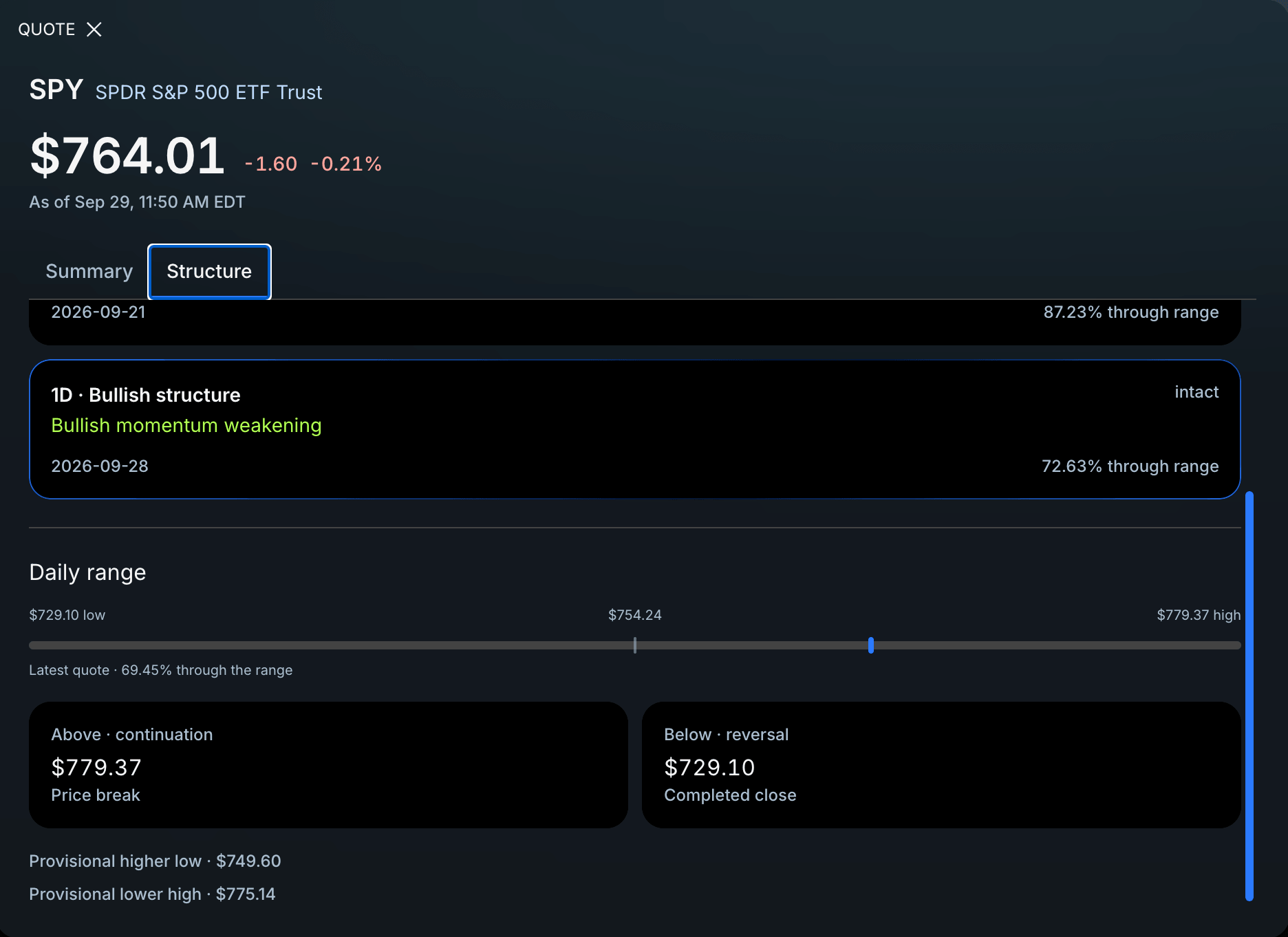
Use Eden’s Quote widget to review structure and momentum. Use Key Levels to mark P-Trans and other areas that matter. Once invalidation is clear, calculate the position size that keeps the loss inside the account-risk limit.
The position-size formula
For a stock or ETF trade:
Shares to purchase = maximum account risk ÷ |entry price − stop price|
The vertical bars mean to use the positive distance between the entry and stop.
Using the Pepsi example:
$500 ÷ |$129.27 − $127.20| = 241.54 shares
Round down to 241 shares. Rounding down keeps the planned risk below $500 before fees and slippage.
How changing the stop changes position size
The account-risk limit can stay at $500 while the number of shares changes.
- A wider stop creates more risk per share, so the trader buys fewer shares.
- A tighter stop creates less risk per share, so the formula allows more shares.
The stop should still come from market structure, momentum, and invalidation. Do not move it only to create a larger position.
How the formula changes for options
One standard equity option contract usually represents 100 shares, so option prices use a multiplier of 100. For a long option with a planned premium-based exit:
Contracts to purchase = maximum account risk ÷ (option premium risk × 100)
If an option is purchased for $4.00 and the premium-based exit is $3.00, the planned risk is $1.00 × 100, or $100 per contract. A $500 risk limit would allow five contracts before fees and slippage.
Options are more complicated because delta, implied volatility, time decay, and spreads can change the option premium before the stock reaches its chart invalidation. If the plan uses a stock-price stop, the future option price at that stock level is only an estimate. Read What Is Swing Trading in Options? before applying the stock formula to an option.
Why the actual loss can be larger
A risk calculation is a plan, not a guarantee.
The loss may be larger when:
- the stock gaps below the stop overnight,
- a stop order fills at a worse price,
- liquidity becomes thin,
- the bid-ask spread widens,
- or the trader does not follow the exit.
Reduce size when an earnings report, major company event, or market-moving announcement falls inside the planned holding period.
If the Pepsi example fell 20% before the trader could exit, the actual loss would be far larger than $500. The $500 limit remains true only when the order fills close to the planned stop. Risk is controlled by both the calculation and the exit.
What is the 2% rule in swing trading?
The 2% rule means limiting the planned loss on one trade to 2% of the account. It does not mean using only 2% of the account to buy the position.
The rule is a ceiling some traders use, not a required target. In this framework, 2% is extremely aggressive. A smaller limit gives the trader more room to survive a losing streak and learn from mistakes.
A pre-trade risk checklist
Before entering, write down:
- account balance,
- chosen risk percentage,
- maximum planned dollar loss,
- planned entry,
- invalidation price,
- risk per share,
- calculated position size,
- scheduled events during the hold,
- and the possible loss if price gaps past invalidation.
If invalidation is missing, position size cannot be calculated responsibly.
Frequently asked questions
Is risking 1% safe?
No percentage makes a trade safe. A 1% plan can still produce a long losing streak, and gaps can make the actual loss larger. It is simply one way to limit planned damage.
Should every trade use the same risk percentage?
Consistency makes results easier to review, but event risk, liquidity, and setup quality may justify using less. A trader does not have to use the full limit.
Can I size the trade first and place the stop afterward?
That reverses the process. Find the market-based invalidation first, choose the maximum account loss, and let those two numbers determine size.
If the stock falls 20%, is my loss still limited to $500?
Only if the position was already closed near the planned stop. If the trader ignores the stop or price gaps through it, the actual loss can be much larger. Position sizing limits planned risk; it cannot guarantee the fill price.
Takeaway
Risk is what the account can lose, while position size is how much capital enters the trade. Choose the risk limit, define invalidation from structure and momentum, and calculate size last. Treat 0.5% as conservative, 1% as more aggressive, and 2% as extremely aggressive within this planning framework.