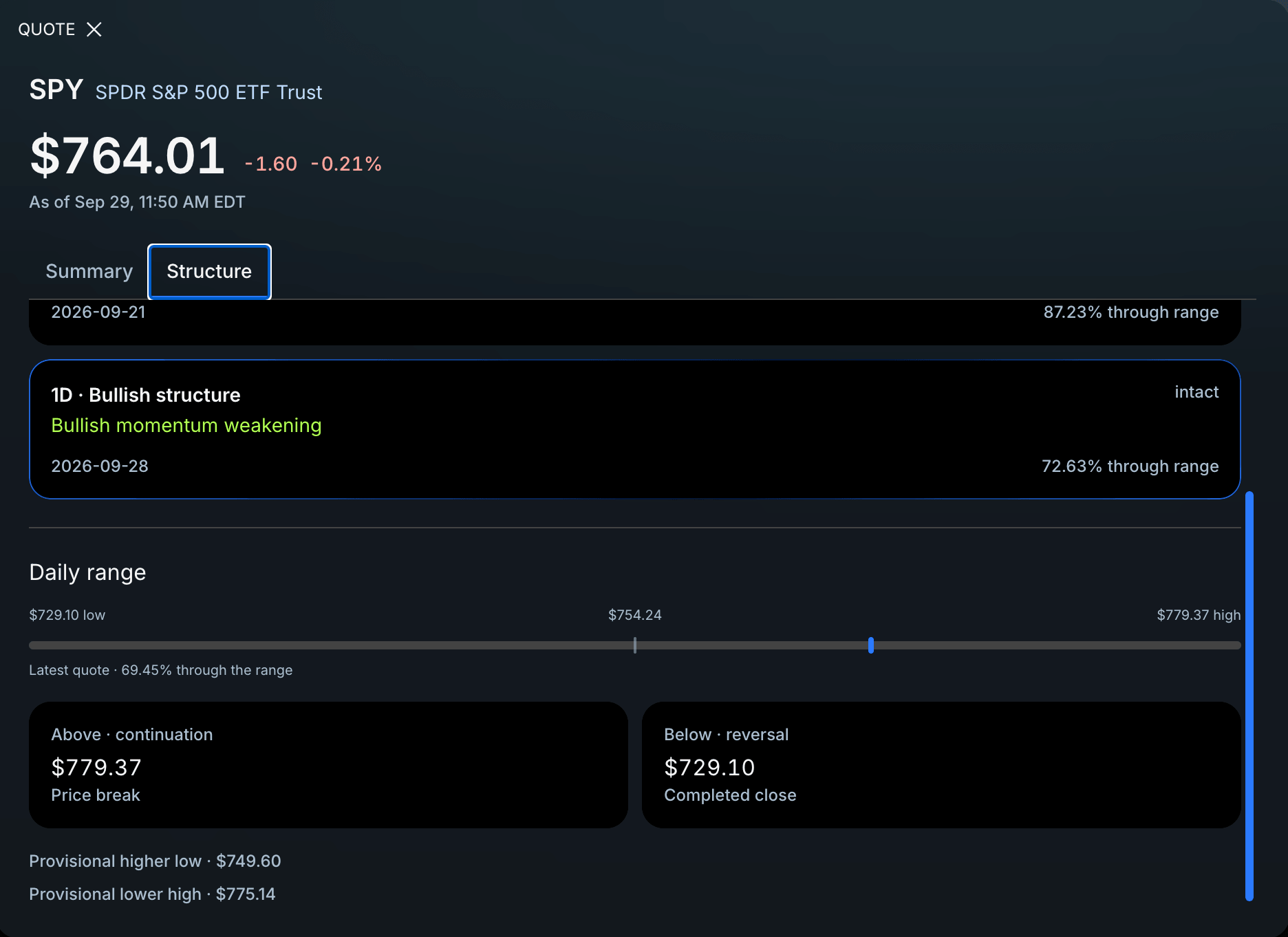
Swing trading means holding a stock, ETF, or option for more than one day to try to capture part of a larger price move. The trade may last several days, several months, or close to a year. At the longer end, the method begins to overlap with position trading.
Swing trading sits between day trading and long-term investing. Read swing trading vs day trading if you are deciding which schedule and risk profile fits you. For this guide, long-term investing means buying something you would be willing to hold for five years or longer.
Think of the market like a staircase. A long-term investor may care about reaching the next floor. A swing trader tries to capture one section of the stairs.
How does swing trading work?
A swing trader begins with a larger time frame. Use the daily, weekly, or monthly chart to decide whether the market structure is bullish or bearish.
For a long trade, look for bullish structure and wait for bullish momentum to begin. For a short trade, look for bearish structure and bearish momentum. Shorting is harder to manage because declines can be sharp and fast. This beginner workflow focuses on long trades because they usually give the trader more time to plan and manage the position.
The trade has five parts:
- Structure: Is the daily, weekly, or monthly structure bullish?
- Momentum: Is bullish momentum beginning or getting stronger?
- Entry: What price behavior starts the trade?
- Invalidation: Has momentum failed on the chart and in the options-positioning data?
- Target: Which weekly, monthly, quarterly, or yearly target fits the planned holding period?
The goal is not to predict every candle. The goal is to define one trade clearly enough to manage it.
How long does a swing trade last?
There is no required holding period. A swing can last a few days, several months, or close to a year. Trades held near the longer end are often called position trades. A long-term investment normally has a much longer goal and may be held for five years or more.
A trade should not stay open only because it has not made money yet. The holding period comes from the setup, momentum, and target. Exit or review the position when momentum dies, the idea is invalidated, the target is reached, or the planned time window ends.
For a trade held over several months, also review the business. Is revenue growing? Is earnings per share, or EPS, improving? Is the reason for owning the company still true? Technical structure and options data show how price is behaving. Fundamentals help explain whether the company supports a longer hold.
What does a beginner swing-trading plan look like?
A beginner can build a bullish swing-trading plan in three steps:
- Look for bullish market structure on the weekly or monthly time frame. You can do this by checking whether price is forming higher swing highs and higher swing lows. Eden’s Quote widget can also identify the larger structure.
- Wait for bullish momentum to pick back up. Structure shows the shape of the market. Momentum shows whether the move is gaining or losing strength. Traders can use momentum indicators, or they can use the Quote widget to see when momentum begins improving.
- Choose a major price target. The four main swing-trading target horizons are weekly, monthly, quarterly, and yearly. Stocks often organize larger moves around quarterly periods. A trade planned for roughly three to six months may use a quarterly target. A trade planned for about eight to twelve months may use a yearly target. The Price Targets widget makes each horizon easy to find.
After the larger bullish setup is clear, use Key Levels to plan the entry. P-Trans is Eden’s bullish trigger level. Watch how price behaves near P-Trans and decide whether your setup requires a hold, reclaim, or clean break before entering.
The workflow is simple:
- Quote widget: Confirm bullish structure and momentum.
- Key Levels widget: Use P-Trans to identify a possible entry area.
- Price Targets widget: Select the weekly, monthly, quarterly, or yearly target that matches the planned holding period.
Eden organizes the structure, momentum, entry area, and potential destination. The trader still defines invalidation, position size, and the exact entry rule before placing the trade.
When the plan is ready and Robinhood is your broker, follow the separate guide to swing trade on Robinhood.
What are the main swing-trading risks?
Overnight gaps
Swing traders hold positions after the market closes. Earnings, economic news, or company announcements can cause the next session to open far above or below the prior close. A stop order cannot guarantee an exit at the stop price during a gap.
Normal market losses
A clear setup can fail. Support can break, a breakout can reverse, and a target may never be reached.
Too much position size
A reasonable chart idea can become dangerous when the position is too large. Risk means the amount the trader is willing to lose if the trade fails. It does not mean the total amount used to buy the position.
One simple account-risk framework is:
| Style | Maximum planned loss on one trade |
|---|---|
| Conservative | About 0.5% of the account |
| More aggressive | About 1% of the account |
| Extremely aggressive | About 2% of the account |
These percentages are planning examples, not safe amounts for every trader. Overnight gaps can make the actual loss larger than planned.
Position size comes after risk. If a trader is willing to lose $50 and the distance from entry to invalidation is $2 per share, the basic size is 25 shares before accounting for gaps, slippage, and fees.
For the complete calculation, read How Much Should You Risk on a Swing Trade?.
Changing the plan after entry
Moving the stop, adding to a losing position, or inventing a new target can turn one controlled trade into a much larger problem.
Is swing trading the same as investing?
No. Swing and position traders focus on a move with a defined structure, momentum condition, invalidation, and target. Long-term investors may hold for five years or longer and focus more heavily on business growth, earnings, income, and broad market exposure.
Frequent short holding periods may also affect taxes. The IRS generally treats gains on assets held for one year or less as short-term capital gains. Tax treatment depends on the person and account, so use current IRS guidance or a qualified tax professional.
A beginner checklist
Before placing a swing trade, answer these questions:
- What is the setup?
- What exact reaction starts the trade?
- Is bullish momentum beginning or getting stronger?
- What proves the idea wrong?
- Does a weekly, monthly, quarterly, or yearly target match the holding period?
- If this is a longer hold, are revenue and EPS moving in the right direction?
- Is there an earnings report or major event during the planned hold?
- What percentage of the account is at risk?
- How much can be lost if price gaps past the stop?
If one answer is missing, the plan is unfinished.
Frequently asked questions
Is swing trading good for beginners?
It can teach planning and patience, but it still carries real risk. Beginners can start with paper trading, small size, and one repeatable setup before adding more strategies.
Why does swing trading work?
Markets often move in waves rather than straight lines. Swing traders try to capture part of one wave. The opportunity exists, but no method wins every time.
How much money do I need to start swing trading?
There is no universal amount. The account must be large enough to size a trade around its invalidation without risking money needed for bills, savings, or emergencies.
Official sources
- Charles Schwab, What Is Swing Trading and How Does It Work?
- Fidelity, What Is Trading?
- IRS, Topic No. 409: Capital Gains and Losses
Takeaway
Swing trading tries to capture part of a larger move over more than one day. Start with daily, weekly, or monthly structure. Wait for momentum, plan the entry near P-Trans, choose the right target horizon, and risk only the amount the account can afford to lose.